


Magnesium Glycinate Capsule Vs Melatonin
If you have trouble sleeping regularly, your first thought probably is to try the supplement melatonin. Many of the people who have taken melatonin for a while will tell you that although it does help you fall asleep, it will leave you feeling groggy or 'not really awake' the next day and your brain will feel foggy and it will feel as though you haven't had a good night's sleep either.
The thing about melatonin is it basically works as a cue to tell your body that "it's dark out," and assists to regulate your circadian rhythm. However, melatonin doesn't get at the core reason for why you have trouble sleeping. Melatonin won't help relieve issues of high stress, a dwelling mind, or an active tense body. So, there are some folks that are now trying out magnesium glycinate. Magnesium glycinate is not a hormone, it works as a "de-stressor" to the nervous system. Magnesium helps relax the nervous system and muscles, while the glycine provides a relaxing sensation. Together, users typically experience less body tension and fall asleep more "naturally" than after having had their "on/off" switch pressed.
There's a different strategy used by each:
So, if you're having trouble sleeping because of irregular sleep schedules, melatonin alone won't be an effective way to resolve that issue.But, many stressed-out people who can't fall asleep no matter how hard they're trying to, choose magnesium to help them relax and feel calm in their body.
Is magnesium glycinate better than melatonin for sleep?
The Melatonin Myth: It doesn't really relax you, it just tells you it's night
Melatonin is essentially an exogenous hormone; it acts more like a signal sent to the brain: "It's nighttime-time to get ready for sleep." The issue is that it merely provides a "time cue" rather than adjusting your physiological state. Consequently, if you struggle to sleep due to work stress, anxiety, or a racing mind, melatonin often isn't very helpful. Your body remains tense and your mind stays active; you simply feel a bit drowsier. This explains why some people, even if they manage to fall asleep, wake up feeling less than fully restored-experiencing a heavy head or slower reactions-as if the overall quality of their sleep has been compromised.

Magnesium Glycinate: It tends to ease the body into a sleep state rather than forcibly inducing sleep
Magnesium Glycinate is a combination of magnesium and glycine. Its idea is completely different from melatonin - it does not "usher you to sleep", but helps the body slowly relax.
The more common mechanisms can be understood as three points:
1. Make the brain less excited
When people are stressed or anxious, it is easy for the brain to remain in a state of "high alert". Magnesium is involved in regulating the balance of excitation and inhibition in the nervous system, making it easier to reduce this overactive state.
2. Help the body switch out of "tight mode"
In fact, many people's insomnia is not only a brain problem, but also a tight body, such as tight shoulders and neck, tossing and turning, or even being unable to stop their legs. Magnesium is involved in physiological processes related to muscle relaxation, so it will feel easier to relax.
3. Make the process of falling asleep more natural
It's not that "suddenly sleepy" feeling, but more like a slow transition from awake to tired, and finally to falling asleep naturally.
Simply put:
Melatonin is more like a signal telling you, "It's time to sleep,"
while magnesium glycinate is more like something that helps lower physical tension, making it easier for you to fall asleep.
Can I Take Melatonin Every Night, or Should I Switch to Magnesium?
Melatonin isn't harmful for most people, but it's often best understood as a short-term tool.
It's a hormone that signals "it's nighttime," helping you fall asleep. The issue is that when people take it every night in relatively high doses, some notice it becomes less effective over time. They may need more for the same effect, and if they stop, their original sleep problems can feel like they come back just as strongly. That's why it can turn into a cycle of using it to sleep, then struggling without it.
so many clinicians don't see melatonin as a long-term nightly solution, but more as something for short-term use like jet lag or schedule adjustment.
Magnesium is different-it's not a hormone, but an essential mineral that supports normal nerve and muscle function. For some people, it helps with overall relaxation, especially when sleep issues are linked to stress or tension.
In simple terms: melatonin is more about sleep timing, magnesium is more about helping the body relax.
Magnesium Reality: A Key Nutrient You Might Be Lacking
The two molecules of magnesium and melatonin function on completely different principles. The molecule of magnesium is not a hormone but an essential mineral that the body needs. (In essence, it is needed for hundreds of basic bodily functions every day.) but cannot be manufactured by the human body (thus the need for external sources of the mineral, either through diet or supplementation. Basically, the amount of magnesium consumed by a lot of people is too low and has been made lower by their bad eating habits and the existence of a lot of stress. So, when you take magnesium supplements, you are just doing something basic to replace what is missing.
The major difference between melatonin and it is that melatonin completely changes sleep rhythms, whereas it will gradually bring a person back to normal sleep rhythms without turning the "off" drowsy switch on and "on" sleep switch.
Supplements have almost no chance of causing dependence because most people cannot manufacture magnesium naturally on their own therefore, taking supplements will not interfere with the natural production of the hormone nor will it increase dependence as one continues using it.
2. effect long-term is the focus of this, not instantaneous
relaxation after it's taken. While melatonin relaxes you the same evening you take it, magnesium takes some time to "build up" in your body before you begin seeing consistent effects from its use. As many people continue to take magnesium supplements, they find that they can relax better naturally at night, especially if they are not feeling the tension or anxiety that they normally feel during the daytime.
Why Does Melatonin Make Me Groggy the Next Day, and Does Magnesium Do the Same?
The "Melatonin Hangover": why you sometimes wake up feeling worse
The dosages themselves are "unnatural"; the amount of melatonin the body naturally produces is minuscule-at the level of trace amounts. However, common supplements on the market often contain 3mg, 5mg, or even more per pill-quantities that far exceed physiological levels.The issue lies here: when the dosage is too high, the body requires time to clear it from the system.Consequently, some people wake up in the morning with residual melatonin still in their bodies, leading to a lingering sense of drowsiness.
While melatonin can certainly help you fall asleep faster, it doesn't necessarily guarantee high-quality sleep. Many people manage to get a full eight hours, yet their sleep cycles remain fragmented, compromising both deep sleep and REM sleep.
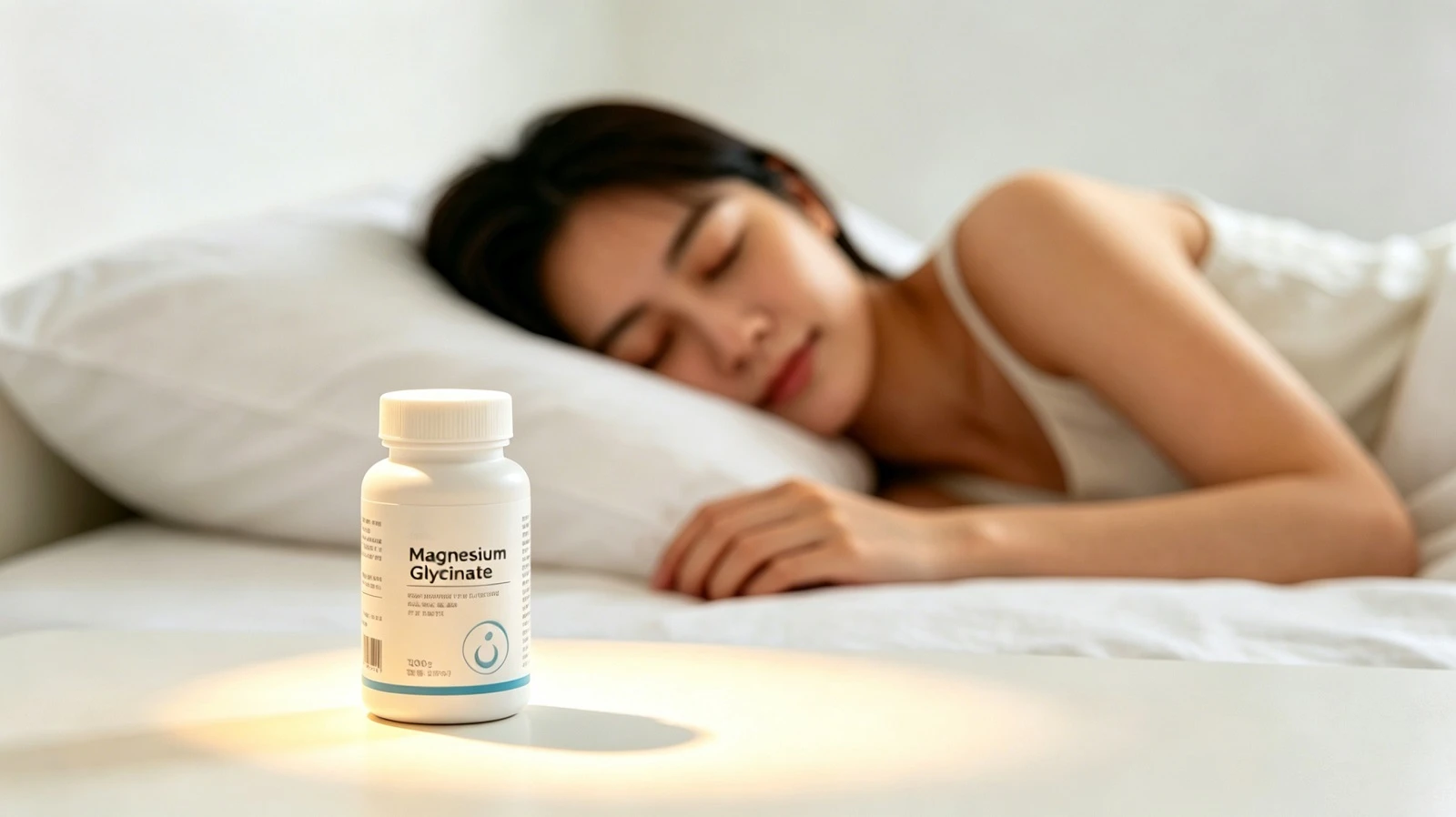
Even if you meet the recommended duration, you may still wake up feeling utterly exhausted, without any sense of having truly rested.
Magnesium glycinate works differently; instead of forcing you to sleep, it gently helps your body relax. Once your nerves are no longer tense and your muscles have eased, sleepiness comes naturally.It causes no grogginess or "sleep hangover," nor does it disrupt your body's natural sleep rhythms. Waking up the next day feeling clear-headed and energetic is the result of falling asleep naturally, rather than being forced into slumber by an external agent.
What Are the Benefits of Magnesium Glycinate vs. Melatonin for Anxiety?
Magnesium Glycinate vs Melatonin: Anxiety and Sleep
If your most important problem(s) is anxiety, being highly stressed out, or having a mind that just won't slow down (or stop) then these two supplements work in fundamentally different ways. Melatonin acts more as a "time signal" to your body, or a cue that it's time for you to go to bed. It does not address why you're basically having a hard time sleeping. You may still be tensed up, or you may continue to have worrisome thoughts. Therefore, while you will probably feel physically drowsy when you ingest melatonin, your mind is probably still not quiet.
Magnesium Glycinate does things differently. It doesn't simply make you sleepy, it actually allows your body to wind down over time. It calms your nerves, relaxes tight muscles and puts you in a "resting" state. This makes you feel sleepy, naturally.
Final Thoughts
Don't let unstable ingredients hold your products back. [Click here to request a sample of our Magnesium glycinate Capsules] and download our exclusive Formulator's Stability Guide to unlock the full potential of copper peptides today!
The concentration and properties of the extract can be customized according to customer needs. Please contact us directly.
Email:haozebio2014@gmail.com
Reference
1.Arendt, J. (2005). Melatonin and human regulation of sleep. Diabetology & Metabolic Syndrome, 7(4), 347–358.
2.Savage, R. A., Zafar, N., Yoloya, Q. E., & John, A. H. (2022). Melatonin therapy for circadian rhythm sleep disorders: A clinical review of long-term efficacy and safety. Journal of Clinical Sleep Medicine, 18(3), 915–923.
3.Boyle, N. B., Lawton, C., & Dye, L. (2017). The effects of magnesium supplementation on subjective anxiety and stress-A systematic review. Nutrients, 9(5), 429. https://doi.org/10.3390/nu9050429
4.Yamadera, W., Inagawa, K., Chiba, S., Bannai, M., Takahashi, M., & Nakayama, K. (2007). Glycine ingestion improves subjective sleep quality in human volunteers, correlating with polysomnographic changes. Sleep and Biological Rhythms, 5(2), 126–131.
