


Copper Peptides Vs. Retinol: Which Is Better For Skin Longevity And Wrinkle Reduction?
Retinol has been the standard anti-aging ingredient for a long time.It's in a lot of skincare products and is often the first thing people try for wrinkles.But recently, more people have started focusing less on just "strong anti-aging" and more on keeping the skin calm, healthy, and less inflamed over time.That's partly why copper peptides (GHK-Cu) are getting more attention.
They work in pretty different ways.Retinol basically pushes your skin to renew faster.That can help smooth fine lines and rough texture fairly quickly, especially on the surface.But it's also the one most associated with irritation, dryness, and that adjustment period where skin can feel worse before it gets better.Copper peptides don't really work like that.Instead of forcing turnover, they seem to support the skin's own repair process.The idea is more about helping the skin rebuild and stay stable, rather than speeding everything up at once.Most people also find it easier to tolerate.So it's less about "which one is stronger" and more about what your skin can actually handle.Retinol is usually better if you want faster surface-level changes and your skin is okay with some irritation.Copper peptides make more sense if you want something gentler that focuses on long-term skin strength and less sensitivity.
The Mechanism Challenge: How Do They Differ in Building Collagen?
To figure out which one actually does better for wrinkles, you have to go a bit deeper than just "it works" or "it doesn't".Both retinol and copper peptides (GHK-Cu) can improve fine lines and make skin look smoother, but they get there in very different ways. Retinol basically works by speeding things up. It pushes the skin to turn over faster, which indirectly leads to more fresh, new-looking skin over time. It's effective, but it does it through a kind of controlled stress. Copper peptides work more quietly. Instead of forcing turnover, they seem to support the skin's own repair signals - especially the processes involved in rebuilding collagen and the deeper structure of the skin. So in simple terms: retinol is about accelerating renewal, while copper peptides are more about supporting repair from within.
Copper peptides, on the other hand, don't really "force" turnover. They act more like a signaling system, nudging the skin's own repair processes - especially those involved in rebuilding the deeper structural layer where collagen lives.
So you end up with two very different mechanisms:
Retinol: increases cell turnover, basically accelerating surface renewal
GHK-Cu: supports internal repair signals, helping rebuild the skin's underlying matrix
Or put more simply: retinol pushes the skin to renew, while copper peptides help it rebuild.
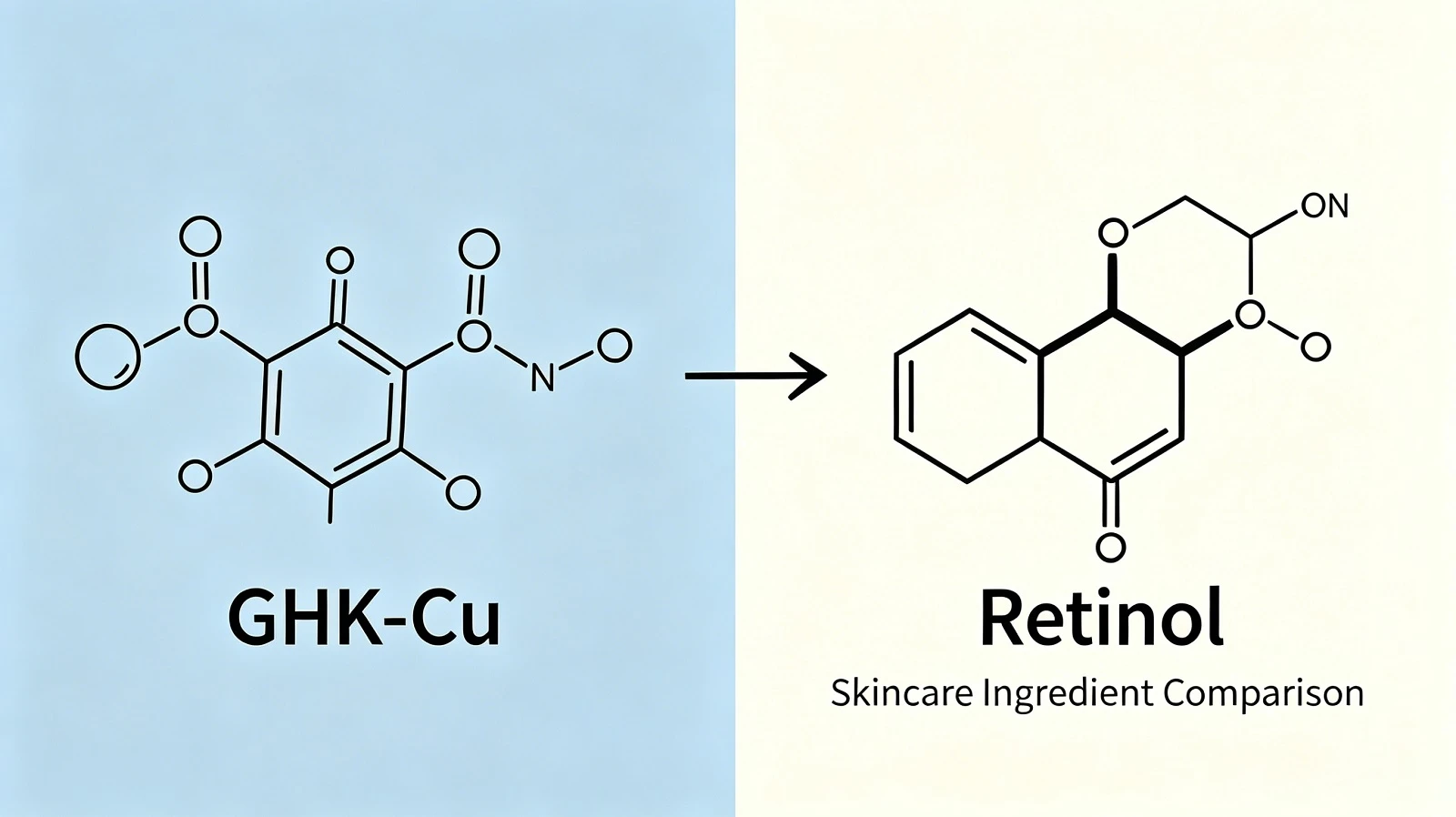
Retinol: The Aggressive Accelerator
Retinol works from the top down. When applied, it converts into retinoic acid, binding to specific nuclear receptors in your skin cells. This triggers a frantic acceleration of cellular turnover, shedding old, dead skin on the surface and forcing the lower layers to rapidly pump out new cells and collagen to keep up.
While highly effective at smoothing out texture and superficial wrinkles, this "forced labor" can leave the skin barrier compromised, leading to the notorious "retinol burn" and localized inflammation.
Copper Peptides: The Bio-Mimetic Architect
Copper Peptides take a bottom-up, bio-mimetic approach. GHK-Cu is a naturally occurring peptide fragment that your body releases whenever tissue is injured. It acts as a signaling molecule, calmly commanding the fibroblasts in the dermis to synthesize not just regular collagen, but high-quality Type I and Type III collagen, alongside elastin and glycosaminoglycans (the skin's natural hydration plumpers).
Instead of forcing renewal through stress, GHK-Cu mimics the skin's natural healing response. It essentially tricks your skin into remodeling its underlying architecture-thickening the dermis and smoothing out deep, structural wrinkles from the inside out, all while actively lowering inflammation.
-
The Takeaway for Formulators and Consumers: If your goal is rapid surface resurfacing and fading superficial fine lines, Retinol delivers quick visibility. However, if you are chasing true skin longevity-rebuilding a resilient, deeply cushioned skin matrix without triggering a chronic inflammatory response-Copper Peptides offer a superior, zero-downtime mechanism.
The Inflammation Factor: Which Wins the "Skin Longevity" Race?
In anti-aging today, the conversation has quietly shifted. It's no longer just about smoothing wrinkles on the surface, but something deeper: skin longevity.
At the center of this idea is a concept called inflammaging - chronic, low-grade inflammation that doesn't cause obvious damage overnight, but slowly wears the skin down over time.
Think of it as a constant background "irritation" in the skin. Over the years, it chips away at collagen, accumulates DNA damage, and pushes cells into early senescence - where they stop dividing properly but don't fully shut off, and instead start releasing signals that can stress surrounding tissue.
The result isn't dramatic at first. It's subtle: skin that heals a bit slower, looks a bit more tired, and loses resilience.
Retinol: powerful, but not exactly gentle
Retinol is one of the most effective ingredients in skincare - but it doesn't work quietly.
When you first start using it, it often comes with a transition period: redness, peeling, dryness, sometimes a mild burning or tight feeling. This is what people refer to as the "retinol purge."What's actually happening is that the skin is being pushed to speed up its turnover process. And while that can lead to clearer, smoother skin over time, the journey itself is essentially a controlled form of stress.
For some skin types, that stress is manageable and even beneficial. But for sensitive or already compromised skin, repeated irritation can become a double-edged sword - potentially reinforcing the very inflammation cycle you're trying to reduce.
Copper Peptides: a calmer way to age skin
Copper peptides (GHK-Cu) work from almost the opposite direction of ingredients like retinol.
Instead of pushing the skin to react through stress, they're more about helping it settle down. GHK-Cu is often described as anti-inflammatory, meaning it helps tone down some of the signals that drive redness and ongoing irritation in the skin.In practical terms, it's less about "forcing change" and more about creating a better environment for repair.When you use copper peptides, the idea is that you're supporting the skin's natural recovery processes - helping it deal with oxidative stress, daily environmental damage, and general wear and tear a bit more efficiently.
Over time, that calmer environment may help preserve the skin's deeper repair systems, including the cells involved in regeneration, so the skin isn't constantly stuck in a low-grade stress state.
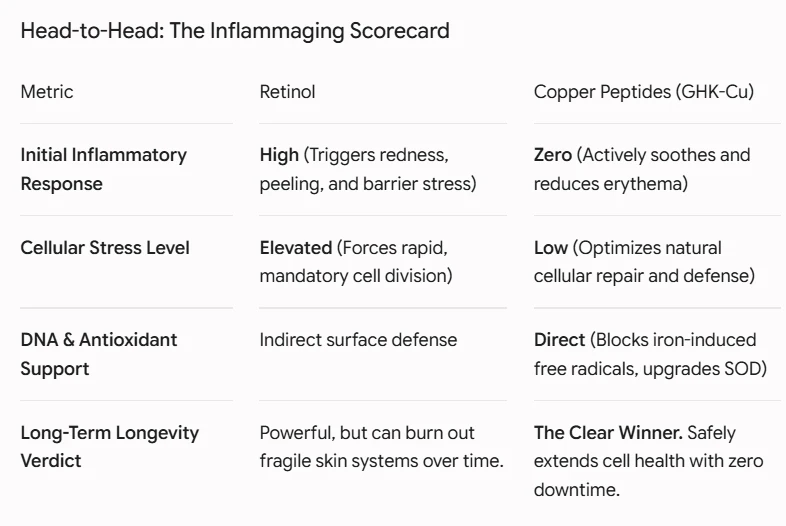
If you view anti-aging as a sprint to quickly peel away surface imperfections, Retinol takes the lead. But if you view it as a marathon for Skin Longevity-where the goal is to keep your cellular matrix healthy, calm, and functioning like young skin for decades-Copper Peptides win the race hands down. GHK-Cu proves that you do not need to destroy the skin barrier today just to have fewer wrinkles tomorrow.
To reduce wrinkles, must we endure the adverse effects of retinol? Can people with sensitive skin directly choose copper peptides?
If you have sensitive skin, you've probably heard that getting rid of wrinkles means going through the painful "retinol purge" first.
Why Retinol Fails Sensitive Skin?
Retinol works by speeding up cell turnover from the surface down.For skin that already has a weakened barrier, that kind of aggressive "push" can lead to dryness, irritation, stinging, and redness.In some cases, it can even make the skin more inflamed and visually aged instead of improved.
Why Copper Peptides Are a Smart "Start Here" Option?
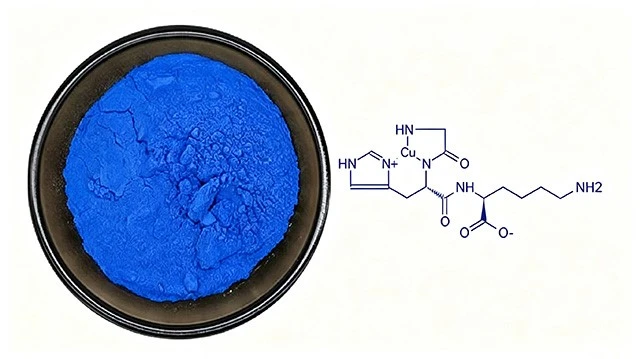
Copper peptides (GHK-Cu) work in a very different way from retinol.Instead of forcing the skin to speed up from the surface, they support repair from the inside out.Because GHK-Cu is a peptide naturally found in the body, skin tends to recognize it more as a repair signal than something irritating.
One of the biggest advantages is how gentle it is.There's usually no purging, no flaking, and no obvious irritation phase.For many people, it just feels like their skin is slowly becoming more hydrated, plumper, and stable over time.
Another key point is barrier support.Retinol can be quite disruptive for some skin types, especially in the beginning, while copper peptides are generally associated with helping the skin barrier stay stronger and more resilient.Over time, that can mean less sensitivity and less reactivity overall.
They're also known for helping calm low-grade inflammation in the skin, which is one of the hidden factors behind collagen breakdown and long-term "tired" looking skin.
The simple takeaway: instead of pushing your skin through a harsh adjustment period, copper peptides offer a more gradual, low-irritation path to firmer, healthier-looking skin.
Retinol vs Copper Peptides: Which Works Faster?
It really depends on what you're trying to fix.
Retinol tends to show faster visible changes in the beginning when it comes to surface-level issues-like rough texture, dullness, and very fine lines.That's mostly because it speeds up how quickly your skin sheds and renews itself.Some people notice a smoother look within a few weeks, but it can come with dryness or irritation at first.
Copper peptides, on the other hand, are less about quick surface peeling and more about longer-term rebuilding.They work deeper in the skin, supporting collagen and overall structure.The changes are usually more gradual-often a few weeks to a couple of months-but tend to feel more stable and less reactive.
Bottom line:If your skin is sensitive or you care more about steady improvement without irritation, copper peptides are usually the easier, more comfortable option.
The Efficacy Showdown: Which Reduces Wrinkles Faster?
When you investment in premium raw materials or a high-end skincare line, you want results-and you want them fast. If your core goal is pure speed in smoothing out the skin, the race between Retinol and Copper Peptides (GHK-Cu) comes down to a battle of surface resurfacing versus deep structural remodeling.
So, which one actually reduces wrinkles faster? The answer depends entirely on the type of wrinkle you are trying to erase.
Retinol: The Sprint Winner for Surface Fine Lines
If you are looking at superficial fine lines, premature sun damage, and uneven skin texture, Retinol wins the speed sprint.
Because Retinol aggressively forces cell turnover at the epidermal layer, it can shed dull, dead skin cells within 2 to 4 weeks. This rapid resurfacing creates an immediate optical illusion of smoother skin and quickly iron out shallow, dry fine lines. However, this speed comes with a catch: the initial plumping is often accompanied by swelling or irritation, and it rarely impacts the deeper foundations of the skin in the short term.
Copper Peptides: The Marathon Winner for Deep, Structural Wrinkles
If you are dealing with deep, static wrinkles-like stubborn forehead lines, nasolabial folds, or loss of elasticity-Copper Peptides take the crown, delivering structural changes within 4 to 8 weeks.
GHK-Cu does not waste time peeling the surface. Instead, it dives straight into the dermis to command fibroblasts to rebuild actual skin density. Clinical studies show that Copper Peptides increase collagen synthesis more effectively than Retinol or Vitamin C over a sustained period. It fills wrinkles from the bottom up by anchoring the skin's structural matrix, ensuring that the wrinkle reduction is permanent and deeply rooted, rather than a fleeting surface effect.
The Speed Verdict
-
Choose Retinol for: Rapid texture smoothing and erasing surface fine lines within 1 month (if your skin can handle the irritation).
-
Choose Copper Peptides for: Fast-tracking deep dermal firming, structural wrinkle reduction, and elasticity bounce within 1 to 2 months with absolutely zero downtime.
Final Thoughts
Don't let unstable ingredients hold your products back. [Click here to request a sample of our 99% Pure GHK-Cu Powder] and download our exclusive Formulator's Stability Guide to unlock the full potential of copper peptides today!
The concentration and properties of the extract can be customized according to customer needs. Please contact us directly.
Reference
1.Pickart, L., & Margolina, A. (2018). Regenerative and protective actions of the GHK-Cu peptide in the light of the new gene data. International Journal of Molecular Sciences, 19(7), 1987. https://doi.org/10.3390/ijms19071987
2.Crespi, O. (2025). Cosmeceuticals for anti-aging: Mechanisms, clinical evidence, and regulatory insights-A comprehensive review. Cosmetics, 12(5), 209.
3.Dou, Y., Lee, A., Zhu, L., Morton, J., & Ladiges, W. (2020). The potential of GHK as an anti-aging peptide. Aging Pathobiology and Therapeutics, 2(1), 58–61.
