


Creatine + Magnesium Glycinate Stick Packs: Five Barriers To The Label Claim
Creatine + Magnesium Glycinate Stick Packs: Where the Label Claim Gets Lost
A creatine and magnesium glycinate stick pack looks like the simplest two-in-one SKU a sports nutrition brand can launch. Both ingredients are white powders with established claims and neither is expensive. In practice the format fails for reasons that have nothing to do with either ingredient's marketing story: a fixed dose budget of roughly 4.8 g of active solids, a solubility ceiling that collapses the moment the drink is chilled, and a cyclisation reaction accelerated by the very acid added to make the product drinkable. This guide works through those constraints in the order a formulator actually meets them.
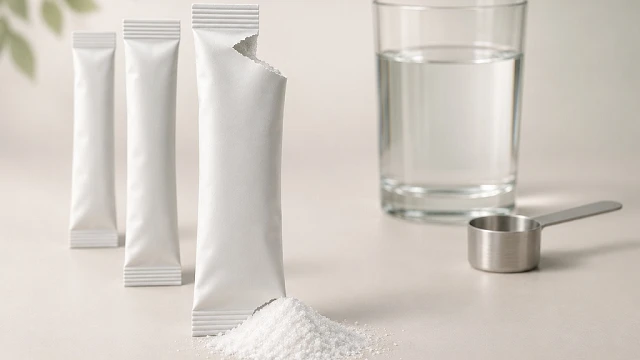
Why Does a 3 g Creatine Claim Force a 4.8 g Serving?
The dose budget is set by claim thresholds, not by preference. The EU register authorises creatine monohydrate for increased physical performance only where the food provides 3 g of creatine per day. Magnesium claims sit on being a source of the nutrient, which under EU reference-intake rules means at least 15% of the 375 mg reference intake, or about 56 mg. Separately, the tolerable upper intake level for supplemental magnesium is 250 mg per day.
Two conversions then fix the serving mass. Creatine monohydrate is 87.9% creatine by mass, so 3 g of creatine requires 3.41 g of monohydrate. Anhydrous magnesium bisglycinate is 14.1% elemental magnesium at its theoretical maximum, so 200 mg of magnesium requires 1.42 g of chelate, rising to 1.77 g at the 250 mg upper level.
Add them and the serving lands between 4.8 g and 5.2 g of active solids before any flavour, sweetener or carrier.
| Format | Creatine | Monohydrate needed | Elemental Mg | Bisglycinate needed | Active solids | Verdict |
|---|---|---|---|---|---|---|
| Stick pack, 200 mg Mg | 3 g | 3.41 g | 200 mg | 1.42 g | ≈4.8 g | Straightforward; leaves room for flavour |
| Stick pack, 250 mg Mg | 3 g | 3.41 g | 250 mg | 1.77 g | ≈5.2 g | Feasible, close to practical fill limits |
| RTD, 500 mL | 3 g | 3.41 g | 200 mg | 1.42 g | dissolved | Feasible with pH and cold-chain control |
| RTD, 250 mL | 3 g | 3.41 g | 200 mg | 1.42 g | dissolved | No headroom once solubility is respected |
| Capsule, size 00 | 3 g | 3.41 g | 200 mg | 1.42 g | ≈4.8 g | ~6 capsules, split across the day |
| Gummy, single piece | 3 g | 3.41 g | - | - | ≈5.2 g | Not physically achievable in one piece |
The gummy row is worth stating plainly. A 3 g creatine gummy would need 3.41 g of monohydrate before any gel former, syrup solid or moisture, which already exceeds the mass of a typical finished gummy. Products sold as creatine gummies therefore deliver either a sub-claim dose or a creatine source other than monohydrate. If the format cannot move, the claim is what has to move.
Why Does Creatine Precipitate in a Chilled Ready-to-Drink?
Creatine monohydrate solubility sits at approximately 13–14 g/L at 20–25 °C, with reported values clustering between 13 and 16 g/L depending on method, and at roughly 6 g/L at 4 °C. Solubility rises almost linearly with temperature, which is the opposite of what a refrigerator does.
At 20 °C, a 3 g dose consumes 215–230 mL of water. In a 250 mL bottle that leaves 20–35 mL to absorb 1.42 g of chelate, the flavour system, any acid and any preservative, with no allowance for saturation margin. Anything past saturation is no longer a solution; it is a suspension that will sediment on the shelf.
Chilled storage is worse. A beverage formulated to saturation at ambient temperature will precipitate when stored or served cold, and the consumer sees a white ring at the bottom of the bottle. The commercial damage arrives well before the analytical damage, because sediment reads as a faulty product long before anyone runs an assay.
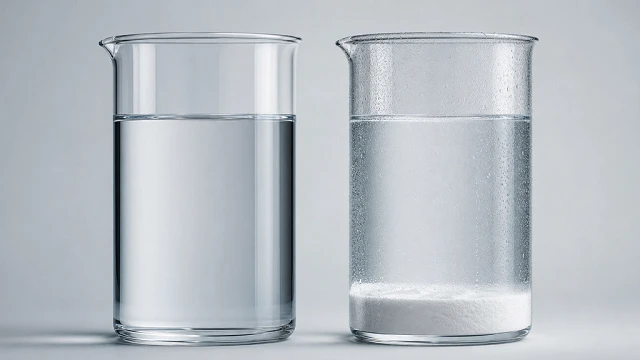
The practical routes are to raise the water volume to roughly 400–500 mL per serving, to lower the per-serving dose with a two-servings-per-day instruction, or to move to a dry stick pack where the solubility ceiling only applies after the consumer adds water.
Why Is the Flavour System the Biggest Threat to Creatine Stability?
In solution, creatine cyclises into creatinine and loses water in the process. The reaction is acid-catalysed and strongly temperature-dependent, and it is irreversible: creatinine will not convert back, and it no longer counts as creatine for label purposes.
That produces the central contradiction of the format. A palatable creatine drink needs acidity, whether from citric or malic acid or a juice base, and acidity is exactly what accelerates the cyclisation. Enough acid to mask the chalky, faintly bitter creatine note shortens the product's useful life; keeping pH near neutral leaves a drink nobody finishes.
There is no clean way to have both in a single-chamber liquid. Formulators generally choose between four compromises.
Keep the liquid near neutral and mask without acid, using sweetener, bitterness blockers and mouthfeel agents. This is the only route that protects the claim, at the cost of severely constrained flavour choice.
Accept the acid and shorten the shelf life, then prove it by measuring creatinine formation at release and at end of shelf life, ambient and accelerated, and setting shelf life from the data rather than the marketing calendar.
Separate the acid from the creatine, either in a dual-chamber sachet or in a dry stick pack where the consumer adds water minutes before drinking rather than months before.
Overage the dose, which is the least defensible option. Adding 10–15% extra creatine inflates cost, does not remove the creatinine an assay will find, and creates a labelling question worth avoiding.
One route that looks tempting does not belong on the list: adding magnesium oxide to raise pH. A buffered, higher-pH blend does slow cyclisation, but magnesium oxide is poorly soluble, lands in the sediment layer, and converts a magnesium glycinate claim into one the COA cannot support.
Why Do Micronised Creatine and Bisglycinate Separate in the Sachet?
A dry blend has one job, which is to stay mixed. Most creatine and magnesium blends do not, and the cause is usually misdiagnosed as bulk density.
Bulk density does differ between the two materials, but the dominant segregation mechanism is particle size. Micronised creatine is typically milled to a D90 below 20 µm so that it wets out quickly, while standard bisglycinate sits in a coarser band with a fluffier structure. A fine, dense, fast-settling fraction next to a coarse, light, aeratable one forms a percolation cell: vibration during palletising, road transport and retail handling lets the fines migrate downward through the voids between coarse particles. Early sachets in a run come out creatine-heavy and later ones magnesium-heavy, while fill weight and appearance both pass.
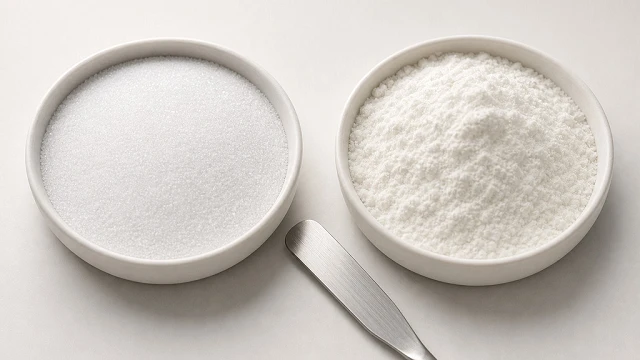
Three controls matter, in this order. Match the particle-size bands at the purchasing stage, either by specifying a coarser creatine or a finer chelate, so the two D50 values sit within roughly a factor of 1.5. Verify uniformity rather than assume it, sampling at least ten points across the batch and off the filler, with a relative standard deviation target of about 3%. And control moisture, because both materials are hygroscopic to different degrees and moisture migration inside a sachet accelerates both caking and creatinine formation.
How Do You Read a Magnesium Bisglycinate COA?
The elemental magnesium figure is the fastest arithmetic test a buyer has. Pure anhydrous bisglycinate cannot exceed 14.1% elemental magnesium, because that ratio is fixed by the molecular weight of 172.47 against magnesium's 24.305. The dihydrate form sits near 11.6%.
Any certificate showing 15%, 18% or 20% is therefore evidence of a blend with a second magnesium source, usually oxide, not evidence of a superior grade. That single number screens suppliers faster than any technical questionnaire, and it also predicts the mouthfeel problem: the insoluble fraction turns chalky in a shaker and settles in a chilled drink.
Two more items belong on the request list. Free glycine tells you how much unreacted amino acid is present, and two lots that both assay at 14% can differ noticeably in bitterness because the elemental figure says nothing about it. Moisture separates anhydrous from dihydrate material and drives caking in storage. Alongside those, ask for creatinine, dicyandiamide, dihydrotriazine and cyanide on the creatine side, and for a particle-size distribution on both.
Final Thoughts
The creatine and magnesium stack is usually presented as a marketing decision. It is a specification decision, and the specification is narrow: a 3 g claim fixes 3.41 g of monohydrate, a 250 mg ceiling fixes 1.77 g of chelate, and everything else follows from those two numbers.
For formulation teams the sequence that avoids most rework is to fix the dose budget first, choose the format that can physically carry it, then lock particle-size bands and moisture limits before the first trial batch rather than after the first stability failure. For buyers and QA, four numbers before approving a lot will tell you more than any brochure: elemental magnesium percentage, free glycine, creatinine and moisture.
Haoze Biotechnology supplies cosmetic and food grade creatine monohydrate and magnesium bisglycinate with batch-specific documentation, including COA, MSDS, specification sheets and batch samples. Formulation teams, OEM manufacturers and brand owners can contact info@haoze-bio.com for technical consultation and application support.
Reference
1.Commission Regulation (EU) No 432/2012. Establishing a list of permitted health claims made on foods, other than those referring to the reduction of disease risk and to children's development and health. Official Journal of the European Union.
2.Regulation (EC) No 1924/2006. On nutrition and health claims made on foods. European Parliament and Council.
3.European Food Safety Authority (NDA Panel). Scientific Opinion on the substantiation of health claims related to creatine pursuant to Article 13(1) of Regulation (EC) No 1924/2006. EFSA Journal, 2011.
4.Jäger, R., Purpura, M., Shao, A., Inoue, T., & Kreider, R. B. (2011). Analysis of the efficacy, safety, and regulatory status of novel forms of creatine. Amino Acids, 40(5), 1369–1383.
5.Scientific Committee on Food (2006). Tolerable Upper Intake Levels for Vitamins and Minerals. European Commission, Health & Consumer Protection Directorate-General.
6.Regulation (EU) No 1169/2011, Annex XIII. Reference intakes for vitamins and minerals (magnesium, 375 mg). European Parliament and Council.
7.United States Pharmacopeia. Creatine Monohydrate monograph: identification, assay and process-related impurity acceptance criteria. USP.
