


Fucoxanthin Vs Astaxanthin: What EU & US Brands Should Verify Before Sourcing
The Two Ingredients Are Not Competing for the Same Slot
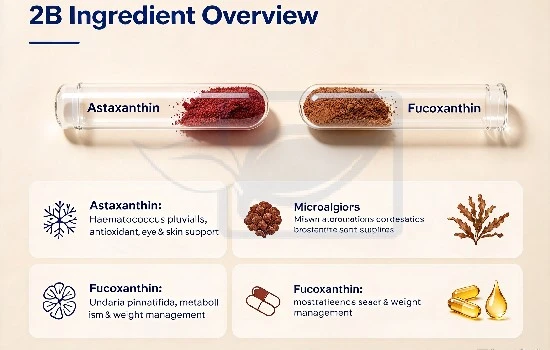
Both come from the sea and both are carotenoids, and that is about where the resemblance ends. Astaxanthin-nearly always Haematococcus pluvialis-is sold first and foremost as an antioxidant: it quenches singlet oxygen, which is why brands lean on it for eye and skin formulas. Fucoxanthin is a brown-seaweed carotenoid (usually Undaria pinnatifida) that the supplement market pushes on metabolism instead-UCP1 thermogenesis, fatty-acid oxidation, weight management. They share a "marine carotenoid" label, but a buyer who treats them as interchangeable is building the wrong product from the start.
Mechanism and Human Data: The Endpoints Are Not the Same
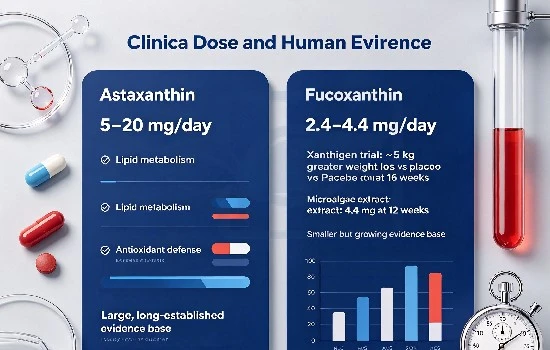
The dose range tells you the positioning at a glance. Astaxanthin studies typically run 4–12 mg a day, and the literature behind it is old and wide-eye strain, skin photoprotection, recovery after exercise. Fucoxanthin sits in a smaller band, usually 2.4–4.4 mg, and the human work behind it is younger and thinner.
|
Parameter |
Astaxanthin |
Fucoxanthin |
|
Primary claim |
Antioxidant, eye & skin support |
Metabolism, weight management |
|
Typical dose |
4–12 mg/day |
2.4–4.4 mg/day |
|
Human evidence base |
Large, long-established |
Small but growing |
|
Form in market |
Oleoresin, microencapsulated powder |
Mostly oleoresin; fewer powder options |
The most-cited fucoxanthin figure is still the Xanthigen trial: 16 weeks on an extract delivering about 2.4 mg of the compound a day, and the supplement group lost on the order of 5 kg more than placebo, alongside higher resting energy expenditure and less body and liver fat [1]. A more recent 12-week study used 4.4 mg from a microalgae extract [2]. For astaxanthin, 5–20 mg capsules have been linked to better lipid metabolism and stronger antioxidant defense [3]. None of this helps if the dose on your COA is wrong-a 5% extract and a 10% extract are not the same product just because the powder weight matches. Check active content, not extract weight.
Frmulation: Both Lipophilic, One Easier to Use
Both are fat-soluble, so softgels and oil blends are their natural home. Astaxanthin has been combined with lutein, zeaxanthin and vitamin E in eye products, with CoQ10 and omega-3 in cardiovascular lines, and with collagen for skin. Its microencapsulated beadlets also let you push it into hard capsules and dry powders without rebuilding the formula.
Fucoxanthin shows up more often next to green tea or pomegranate seed oil in metabolism products-that second pairing is the one used in the Xanthigen trial, and taking a fat-soluble carotenoid with fat genuinely improves absorption. If you need it in a dry matrix, expect more friction: beadlet and spray-dried versions are scarce, and the molecule does not survive hot granulation well, so the processing window is tighter.
Market Size: Fucoxanthin Is Small and Growing Faster
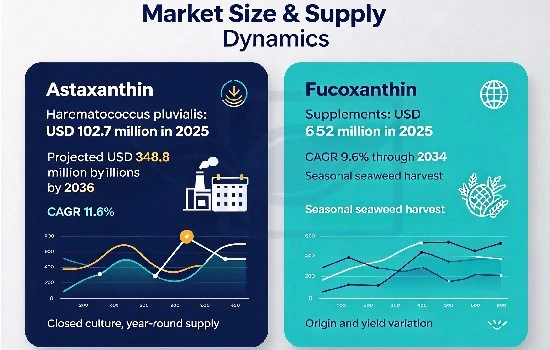
The two markets move at different speeds, and the gap is mostly a matter of where each sits in its life cycle. The Haematococcus pluvialis segment alone was worth about USD 102.7 million in 2025 and is projected to reach roughly USD 348.8 million by 2036-a CAGR around 11.6% [4]. Fucoxanthin supplements started lower, about USD 652 million in 2025, but are forecast to grow near 9.6% through 2034 [5].
For procurement, the point is maturity, not size. Astaxanthin benefits from well-established suppliers and continuous closed-photobioreactor culture, so supply stays dependable year-round. Fucoxanthin rides on seasonal seaweed harvests, which are more exposed to ocean conditions-expect availability gaps and price swings, and ask for the harvest calendar plus a documented buffer-stock policy before you pin a launch date to a single source.
Geography matters at the batch level too. Most commercial astaxanthin comes from dedicated producers in the US, Israel and Asia running controlled culture, which keeps origin consistent. Fucoxanthin tends to trace back to coastal harvests in specific regions, and origin moves both the arsenic profile and the per-batch yield. Put country-of-origin documentation and per-batch yield records into the supplier questionnaire.
Stability: Heat Separates Them
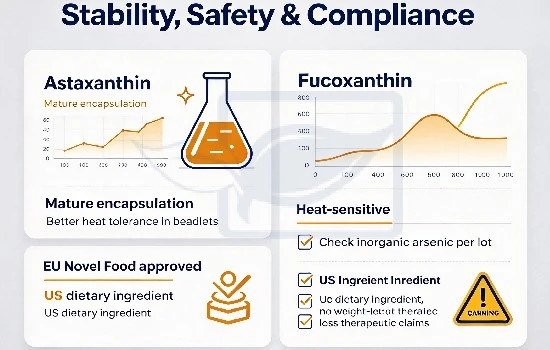
Both are fragile to light, oxygen and heat-just to different degrees. Astaxanthin has a mature encapsulation toolkit, so beadlets and powders hold up through routine granulation and compression, and shelf-life claims are dependable. Fucoxanthin is the fragile one: hot granulation or spray drying degrades it faster, which pushes you toward lower-temperature processing and careful encapsulation.
The QA routine should differ accordingly. For astaxanthin, watch isomer content (3S,3'S) and oleoresin oxidation over the shelf-life claim. For fucoxanthin, run accelerated thermal and light-stress studies early, confirm the carrier oil is actually protecting the molecule, and keep best-before dates conservative until real-time data catch up.
Regulatory and Safety: Novel Food Status, and the Arsenic Question
This is where they diverge most. Astaxanthin from Haematococcus pluvialis is a settled dietary ingredient in the US and an approved novel food in the EU; synthetic astaxanthin is far more restricted on an EU supplement label. Fucoxanthin has to be checked case by case-its novel food status depends on the seaweed species and the extract-and while it can be used as a dietary ingredient in the US, a weight-loss therapeutic claim is off the table.
On safety, the screening item that matters most for fucoxanthin is inorganic arsenic, because wild and nearshore-harvested brown seaweed can accumulate it. Ask for a dedicated inorganic-arsenic assay on every lot, not just a combined heavy-metal panel. Astaxanthin from closed culture generally carries less heavy-metal exposure, but run the full panel anyway and confirm solvent-residue limits in the COA.
Cost and Supply: What a Quotation Doesn't Tell You
On a per-milligram-of-active basis, fucoxanthin usually costs more than natural astaxanthin and comes with steeper minimums. Astaxanthin has a wide, competitive supplier base and continuous culture, so pricing stays relatively flat. Fucoxanthin, tied to seasonal harvest, can swing across the year.
When you compare quotes, look past the powder price. Confirm the HPLC method on the COA-seaweed extracts carry brown-algae polyphenols and chlorophyll that can throw off the assay-and make the certificate state active fucoxanthin separately from total extract. A price per kilo of extract means little unless you are comparing the same active content.
Consumer Perception and the Claim Trap
Astaxanthin is one of the more recognizable marine antioxidants, so consumer education is cheap and claims sit comfortably inside structure-function language. Fucoxanthin is niche, which means a launch carries more education cost-and more temptation to reach for a weight-loss claim that regulators in both markets will reject for a supplement.
Keep the label honest. "Supports metabolism" or "contributes to lipid metabolism" fits the evidence; "burns fat" does not. This is partly a compliance issue, but it is also a retail one: a claim that outruns the data invites scrutiny and erodes buyer trust.
Choosing: Match the Endpoint, Not the Price
If the brief is eye health, skin antioxidant support, or a product that needs to hold on the shelf, astaxanthin is the lower-risk path: more human data, mature encapsulation, a compliant supply chain. Choose fucoxanthin when the positioning is genuinely about metabolism, you can run cooler processing, and you have budget for education.
Before you sign for fucoxanthin, verify three things: the inorganic-arsenic assay, thermal-stability data, and the seasonal supply plan. Many buyers run a small pilot batch in the actual dosage form before committing volume, because encapsulation behavior varies by source batch and is the variable that most often sinks a fucoxanthin launch. Whichever you pick, price on active content, confirm the source or isomer, and keep the claim inside what the regulation allows.
Summary
These are not interchangeable. Astaxanthin is the safe, well-documented choice for antioxidant and eye-skin positioning; fucoxanthin buys you a differentiated metabolism angle at the price of tighter diligence on arsenic, heat stability and seasonal sourcing. Match the ingredient to the endpoint, price on active content, and verify the safety panel-that is what keeps a launch defensible. Most brands starting with an eye or skin product will land on astaxanthin; a metabolism line with the patience for education is where fucoxanthin earns its keep.
References
[1] Jeukendrup A, et al. The effects of Xanthigen in the weight management of obese premenopausal women with non-alcoholic fatty liver disease. Obesity Reviews. Clinical trial evaluating 16-week fucoxanthin supplementation (2.4 mg/day), reporting ~5 kg greater body weight loss in the intervention group, elevated resting energy expenditure and reduction in hepatic and body fat.
[2] PMC (PubMed Central). Clinical Study on microalgae-derived fucoxanthin, 12-week human trial with 4.4 mg daily dosage, investigating metabolic and antioxidant biomarkers. PMC Article ID: PMC11013338.
[3] PMC (PubMed Central). Human research for natural astaxanthin from Haematococcus pluvialis, covering lipid profile improvement and systemic antioxidant defence at daily doses of 5–20 mg. PMC Article ID: PMC7177665.
[4] Meticulous Research. Global Haematococcus pluvialis (astaxanthin) raw material market report. Market valuation USD 102.7 million (2025), projected USD 348.8 million by 2036; compound annual growth rate (CAGR) 11.6%.
[5] Dataintelo. Global fucoxanthin dietary supplement market analysis. 2025 market size USD 652 million, forecast CAGR of 9.6% through 2034.
