


Ergothioneine Vs. L-Ascorbic Acid: Which Antioxidant Actually Works Better For Skin?
Ergothioneine vs. L-Ascorbic Acid: Which Antioxidant Actually Works Better for Skin?
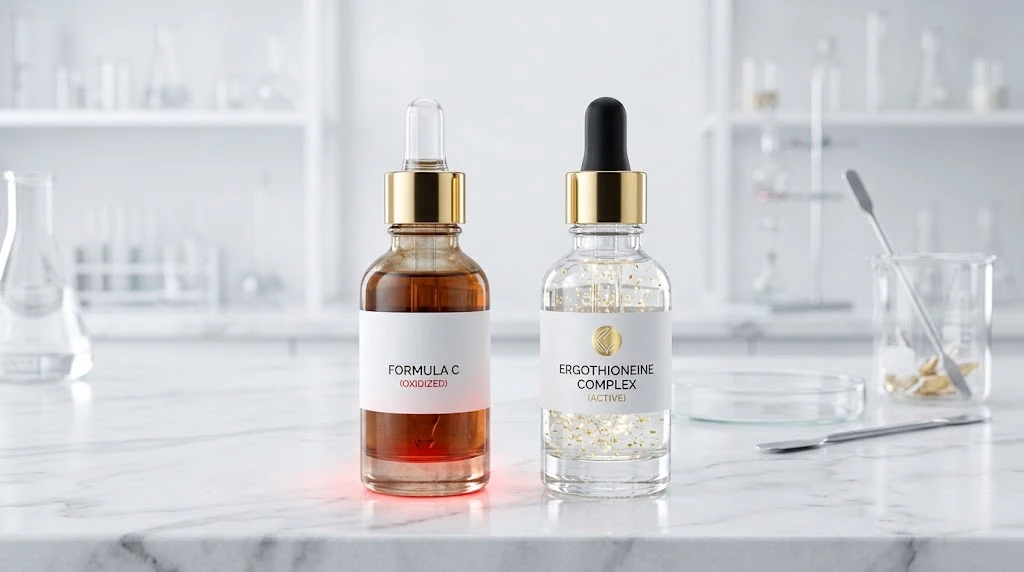
For decades, pure L-Ascorbic Acid (Vitamin C) has been the undisputed gold standard of skincare antioxidants. It's the go-to ingredient for brightening dull complexions and fighting free radical damage that speeds up skin aging, backed by years of solid research. But no skincare ingredient is perfect. Anyone who's splurged on a premium Vitamin C serum knows its frustrating flaws: it oxidizes quickly, turning into that dark amber brown mess, and its high acidity often stings, burns, or irritates sensitive skin.
This is where Ergothioneine (EGT) steps in. Dubbed the "longevity antioxidant", it's been quietly taking over high-end skincare formulas for good reason. Unlike conventional antioxidants that break down fast and work randomly on the skin's surface, EGT acts with precise cellular-level protection. It even has a dedicated transport system that naturally exists in the human body to help it work smarter, not harder. So is Ergothioneine finally a worthy rival to classic Vitamin C, or just another fleeting skincare trend? Let's break down the real science to see which antioxidant truly delivers on its promises.
Meet the Two Antioxidant Powerhouses
L-Ascorbic Acid (Pure Vitamin C)
Pure Vitamin C is the tried-and-true, well-researched workhorse of topical skincare. It donates electrons quickly to neutralize harmful ROS (reactive oxygen species), boosts natural collagen production, and blocks tyrosinase-the enzyme that triggers dark spots-to fade hyperpigmentation and even out skin tone. Still, it has major formulation downsides. It's extremely unstable and only works effectively in a highly acidic pH (below 3.5). This harsh acidic environment often weakens the skin barrier, leading to constant irritation and sensitivity.
Ergothioneine (EGT) Powder
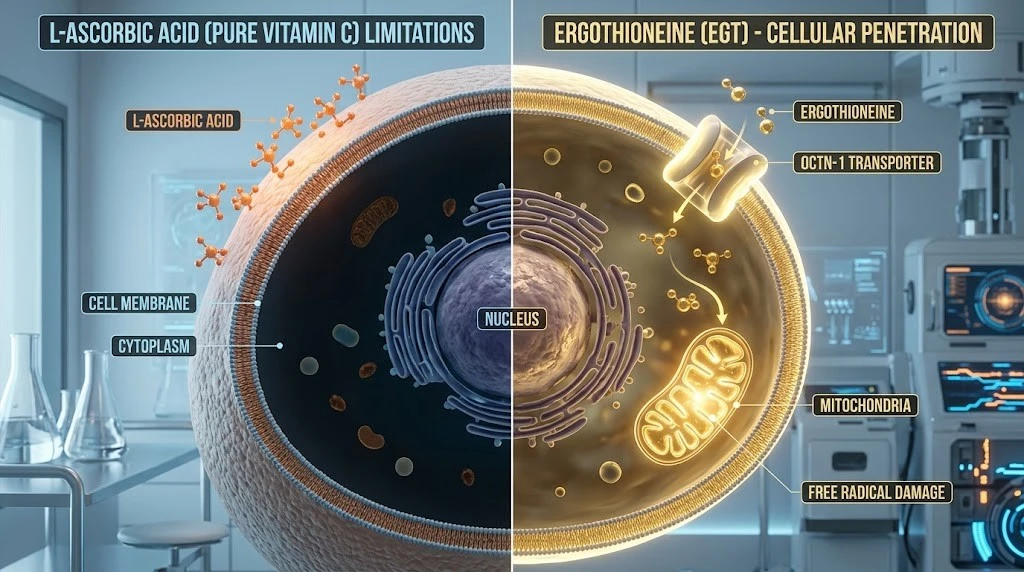
Ergothioneine is a rare, naturally derived amino acid compound sourced from specialized fungi and microorganisms. Widely known as the "smart antioxidant", it leverages the body's unique OCTN-1 transporter protein to travel directly into mitochondria-the cell's core powerhouse where skin aging primarily starts. It boasts unbeatable heat and light stability, causes zero skin irritation, and has a far longer retention time in skin tissue than standard antioxidants, delivering round-the-clock protection.
Frequently Asked Questions
1. Is Ergothioneine more effective than Vitamin C?
True antioxidant power isn't just about how fast an ingredient scavenges free radicals in a lab test. It comes down to targeted cellular delivery, long-term stability, and safe, effective action mechanisms-and this is where EGT outperforms Vitamin C by a wide margin.
Targeted deep-cell protection: L-Ascorbic Acid mostly works on the skin surface and in outer cell areas. It acts as an external defender only. In contrast, the human body has a built-in OCTN-1 transporter specifically designed to carry Ergothioneine straight into high-stress cell zones, especially the mitochondria. Over 90% of aging-causing free radicals are produced inside mitochondria, meaning EGT fights skin damage right at its source, while Vitamin C only treats the surface symptoms.
Safer profile with no pro-oxidant risk: At high concentrations, or when exposed to metal ions like iron and copper naturally present in skin, pure Vitamin C can trigger Fenton reactions. This turns the antioxidant into a pro-oxidant that generates more harmful free radicals and damages skin cells. Ergothioneine binds stably with metal substances and never turns against the skin under normal physiological conditions.
Long-lasting protection: Vitamin C gets used up and flushed out quickly once oxidized, so its benefits fade fast. Thanks to the body's OCTN-1 recycling system, Ergothioneine stays stored in skin tissues for a long time, delivering continuous anti-photoaging and antioxidant defense.
To sum it up: Vitamin C is amazing for quick surface brightening, but Ergothioneine provides superior deep cellular repair, stable long-term protection, and true mitochondrial anti-aging benefits.
2. Can you mix Ergothioneine and Vitamin C? Do they clash?
Absolutely-pairing these two ingredients creates a powerful synergistic antioxidant network that makes your skincare work way better.
Skin antioxidants never work alone; they rely on chain reactions where one ingredient regenerates and supports another. When Vitamin C neutralizes free radicals, it becomes oxidized and inactive. Ergothioneine steps in to stabilize skin oxidative stress, support the skin's natural antioxidant system (including Glutathione and Vitamin C regeneration), and extend the overall effectiveness of your skincare formula.
Together, they create multi-layered skin defense: Vitamin C tackles surface-level environmental damage and daily dullness, while Ergothioneine penetrates deep into cell mitochondria to block UV-induced oxygen damage and slow down MMP-1 collagen breakdown.
Best of all, EGT has an ultra-wide stable pH range (3.0 to 9.0) and tolerates high temperatures well. It mixes perfectly with pure Vitamin C or stabilized Vitamin C derivatives with zero chemical degradation, no precipitation, and zero ingredient conflict.
3. Why is Ergothioneine more expensive than regular Vitamin C?
The price gap boils down to huge differences in production difficulty, sourcing limitations, and purity standards-no arbitrary brand markup.
L-Ascorbic Acid is mass-produced globally through simple, large-scale chemical synthesis. The mature manufacturing process allows high output at extremely low costs, making it an affordable commodity ingredient.
Ergothioneine is a completely different story. Its complex chiral chemical structure cannot be replicated with standard chemical synthesis. Premium skincare-grade EGT requires advanced synthetic biology and precise microbial fermentation, plus strict multi-step purification to achieve pharmaceutical-level purity. The complex production process naturally drives up costs.
It's also far more potent at low doses. Thanks to the efficient OCTN-1 delivery system, EGT delivers visible clinical benefits at just 0.1%–2.0% concentration. Vitamin C usually needs 10%–20% high concentration just to compensate for its poor stability and low skin absorption rate.
Additionally, high-purity Ergothioneine never discolors or degrades over time, drastically reducing formula oxidation issues and product spoilage. It offers far better long-term value for both formulators and skincare users.
4. Which one is better for sensitive, acne-prone, and easily red skin?
For anyone with a fragile, sensitive, inflamed, or breakout-prone skin barrier, Ergothioneine is clinically proven to be the safer, more effective option.
To penetrate the skin, L-Ascorbic Acid requires an extremely acidic formula (pH 2.5–3.5). This harsh acidity strips the skin's natural protective acid mantle, causing stinging, redness, increased transepidermal water loss, and barrier damage-issues that worsen sensitivity and acne inflammation.
Ergothioneine works perfectly at skin-friendly neutral pH levels (5.5–6.5), so it delivers full benefits without any acidic shock to the skin barrier. It also acts as a soothing anti-inflammatory antioxidant, inhibiting the NF-κB inflammatory pathway and reducing skin redness and micro-inflammation-the root causes of sensitive and problematic skin.
Pure Ergothioneine formulas are non-irritating and completely non-comedogenic. Unlike harsh high-acid Vitamin C serums that rely on aggressive penetration enhancers, EGT calms upset skin, protects active breakouts, and restores skin comfort without clogging pores.
Conclusion
L-Ascorbic Acid will always hold a classic place in skincare for its instant surface brightening effect. But skincare science has advanced significantly, and we now know surface-level care is not enough for long-term anti-aging results.
Ergothioneine represents the next generation of precision skincare. With exclusive mitochondrial targeting via the natural OCTN-1 transporter, industry-leading stability, and zero irritation, it solves almost every major downside of traditional Vitamin C. It offers a smarter, longer-lasting way to defend skin against environmental aging and cellular damage.
Whether used alone as a deep cellular shield or layered synergistically with Vitamin C, Ergothioneine is not a passing beauty trend. It's the new modern standard for gentle, precise, and high-performance antioxidant skin protection.
References
1. Paul, B. D., & Snyder, S. H. (2010). The unusual amino acid L-ergothioneine is a physiologic cytoprotectant. Cell Death & Differentiation, 17 (7), 1134–1140. (Validates Ergothioneine's natural cellular protection function and transport mechanism in human skin cells.)
2. Gründemann, D., et al. (2005). Discovery of the ergothioneine transporter. PNAS, 102 (14), 5256–5261. (Landmark study identifying the exclusive OCTN-1 transporter protein for Ergothioneine cellular absorption.)
3. Halliewell, B., Cheah, I. K., & Tang, R. M. Y. (2018). Ergothioneine-a diet-derived antioxidant with therapeutic potential.FEBS Letters, 592 (20), 3357–3366. (Comprehensive review of Ergothioneine's superior stability, non-pro-oxidant safety, and full antioxidant advantages over conventional antioxidants.)
4. Telang, P. S. (2013). Vitamin C in dermatology. Indian Dermatology Online Journal, 4 (2), 143–146. (Summarizes L-Ascorbic Acid's skincare benefits alongside its core formulation flaws: high acidity and easy oxidation.)
