


NMN Vs NR: What Supplement Brands Should Verify Before Sourcing
the Two Are Both NAD+ Precursors, Not Interchangeable Inputs
NMN (β-nicotinamide mononucleotide) and NR (nicotinamide riboside) both work on the same end goal-raising cellular NAD+-but a buyer who treats them as interchangeable will walk into regulatory and cost surprises. NMN is the newer, higher-premium molecule with a strong longevity story; NR is the older, better-documented ingredient with a larger body of human data and a wider regulatory runway. Both have real human clinicals behind them, yet the two differ sharply on stability, dosage response, market access and price. That gap decides which one belongs in your product-and in which market-long before launch.
Mechanism and Human Data: Same Goal, Different Dose Response
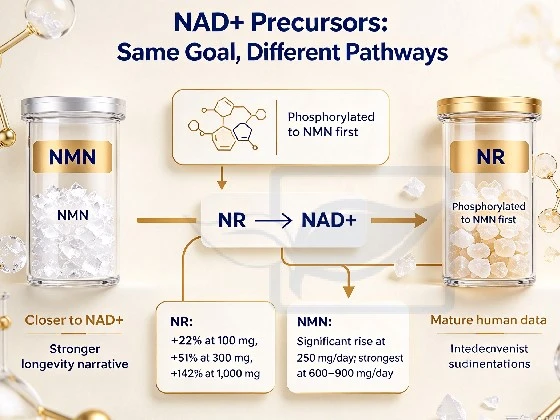
Both are NAD+ precursors, but the metabolic step and the published dose-response differ. NR is phosphorylated to NMN and then converted to NAD+; NMN is one step closer to NAD+, which is the source of its "direct precursor" marketing edge. In the key Conze 2019 trial, 140 overweight adults took 100, 300 or 1,000 mg NR per day for eight weeks; whole-blood NAD+ rose dose-dependently-around +22% at 100 mg, +51% at 300 mg and +142% at 1,000 mg, with no niacin-type flushing [1][2]. NMN has its own placebo-controlled data: 250 mg/day for 12 weeks significantly raised blood NAD+ in healthy adults [3], while a multicenter dose-response trial found NAD+ climbed across all NMN groups, with the strongest levels at 600 and 900 mg/day [4].
|
Reference point |
NR (nicotinamide riboside) |
NMN (β-nicotinamide mononucleotide) |
|
Reported NAD+ response |
+22% (100 mg), +51% (300 mg), +142% (1,000 mg) |
Significant rise at 250 mg/day; highest at 600–900 mg/day |
|
Key clinicals |
Conze 2019 (140 subjects); Martens 2018 |
250 mg 12-wk; multicenter dose-response trial |
|
Human data volume |
Larger, multi-RCT |
Growing but smaller |
|
Usual tested dose |
100–2,000 mg/day |
250–1,250 mg/day |
Read those numbers with care. The dose-response curves are not head-to-head trials, so comparing "+142% for NR" against "+significant rise for NMN" is not a fair fight. What the literature supports is that both work at human-relevant doses and both are well tolerated. In the longer NMN work, 1,250 mg/day for 24 weeks was also reported as well tolerated with no serious adverse events causally linked to the ingredient, which gives buyers more headroom when setting a label dose [4]. Safety reporting is broadly similar on both sides: mild GI discomfort is the most common note at higher doses, while the niacin-type flushing seen with other B3 forms has not been a feature of either NR or NMN in the published trials. For a claim you can defend, anchor on a study that matches your dose and your population, and keep the wording inside structure-function language rather than disease language.
Stability and Shelf-Life: Heat and Moisture Separate Them
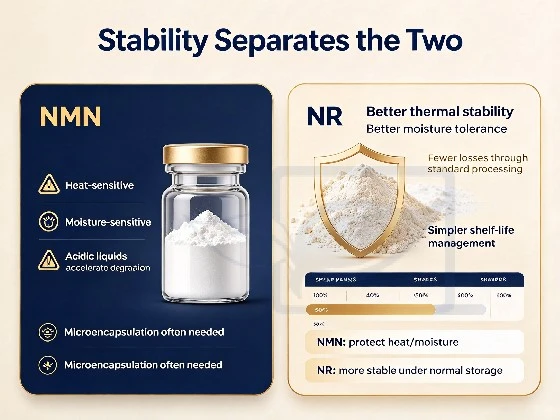
NMN is the fragile one. It degrades under heat, moisture and acidic conditions, so raw powder needs careful storage, and capsule or powder formats must control temperature and humidity through production and distribution. Many suppliers offer microencapsulated or coated NMN to extend stability; expect that added delivery step to raise the finished ingredient cost and to add one more variable to qualify. NR is markedly more stable under normal storage, which is why it moves through standard granulation, compression and bottling lines with fewer losses. If your factory runs warm, humid or long logistics routes, stability alone can tip the decision-run a three-month accelerated study at 40°C/75% RH on the finished base before you commit volume, and choose packaging (opaque bottles, desiccant, moisture-barrier blisters) that protects the actives over the full shelf-life claim you intend to print.
Regulatory Status: The Single Biggest Divider
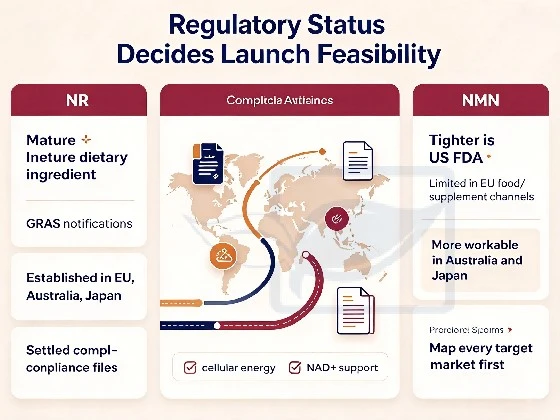
This is where NMN and NR really separate. NR is a mature dietary ingredient with GRAS notifications in the US and established use in the EU, Australia and Japan, so compliance files and label claims are comparatively settled. NMN is in a tighter spot: the US FDA has moved against NMN as a dietary ingredient in some cases, and EU regulators have generally not cleared NMN as a food/supplement ingredient, forcing many brands to sell into regions with a defined pathway or to reposition the product. Some markets, notably Australia and Japan, offer more workable notification routes, which is why much of the finished-product growth has concentrated there. Before you source, map the regulatory path in every market you plan to enter-this, more than efficacy, decides whether your launch is even possible. Ask for a compliance file that covers the specific claim wording allowed in each target market, because "supports cellular energy" may pass in one region while "boosts NAD+ levels" draws a warning letter in another.
Purity, Testing and COA Consistency
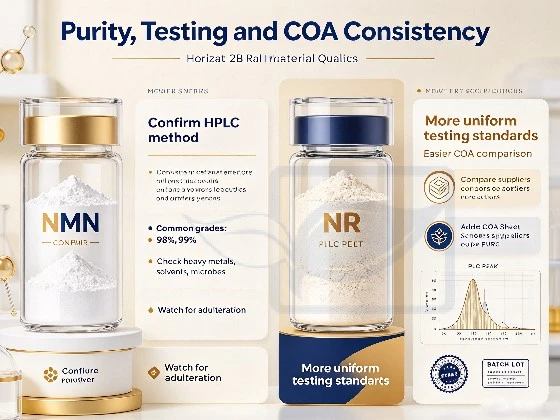
The market is crowded with low-purity and adulterated NMN-some lots are cut with nicotinamide or NR to cheapen the fill. Confirm the HPLC method on the COA, the declared purity (98% vs 99%), and the impurity profile (heavy metals, residual solvents, microbes), and check batch-to-batch consistency across more than one lot. NR benefits from a more uniform industry testing standard, so certificates are easier to compare between suppliers. Price per unit of pure active, not per kilo of powder, and ask for a third-party assay on at least one lot before committing volume.
Because NMN supply is concentrated in a smaller pool of factories, build a shortlist of at least two qualified suppliers for the hero ingredient, even if you buy most volume from one-that improves both price leverage and continuity. Confirm production capacity, export documentation and a documented buffer-stock policy so a supply gap does not stall a launch date. NR's wider supplier base makes this qualification easier, but the same two-supplier discipline still pays off, and it matters even more for NMN where a single factory outage can ripple across the market.
Market Size and Pricing: Premium Story Versus Volume Economics
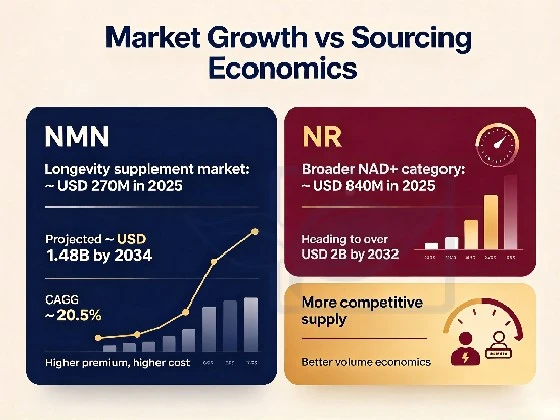
The numbers show a fast-growing but still premium category. The NMN longevity supplement market was valued around USD 270 million in 2025 and is projected to reach roughly USD 1.48 billion by 2034, a CAGR near 20.5% [5]; broader NAD+ supplements were about USD 840 million in 2025, heading to over USD 2 billion by 2032 at a 13.9% CAGR [6]. That growth is concentrated in markets that opened a clear regulatory lane, which is why finished-product demand has clustered in regions with defined notification routes. High-purity NMN commands a higher per-milligram-of-active price than NR, and its supply is concentrated in a smaller pool of factories, so minimums are steeper and lead times longer. NR rides on a wider, more mature supplier base, which keeps pricing more competitive and supply steadier.
Formulation Compatibility and Consumer Positioning
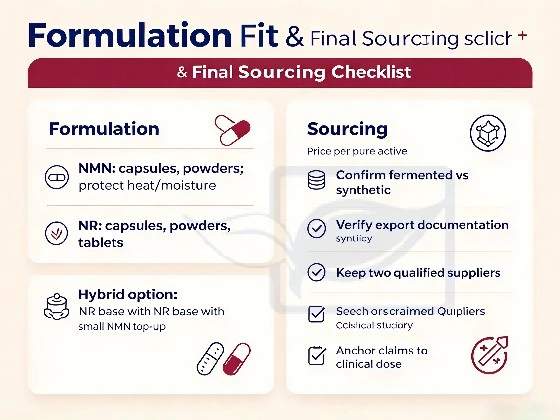
Both fit capsules, powders and tablets, but NMN's pH and heat sensitivity limits it in acidic liquid formats and pushes you toward encapsulation. NR is more forgiving across dosage forms. On the brand side, NMN carries a stronger "longevity / direct NAD+ precursor" narrative and higher premium headroom, at the cost of more consumer education and a claim that regulators in several markets will not let you print directly. NR is a familiar name with steady demand but thinner differentiation, which makes it harder to command a premium. Match the ingredient to the product's price point and story: NMN for a premium longevity line where you can fund education, NR for a proven, budget-conscious NAD+ supplement that needs to move volume. A hybrid approach also works-NR as the base with a small NMN top-up gives you the story without the full regulatory and cost load.
Choosing: Match the Endpoint, Not the Trend
If your priority is regulatory certainty, mature human data and supply stability at a competitive price, NR is the lower-risk call. If your brand wants the premium longevity positioning, can absorb a higher ingredient cost, and you have a clear regulatory path for NMN in your target markets, NMN is the differentiator. In either case, confirm the source (fermented vs synthetic), price on active content, and keep the label claim inside what the evidence and the regulation allow. Ask the supplier for the clinical studies that match your planned dose and population, and for a compliance briefing that lists exactly which claims are usable in each market you ship to-that saves both time and legal risk on every launch.
Summary
NMN and NR are not drop-in substitutes. NR wins on regulatory maturity, human-data depth, stability and supply stability; NMN wins on premium longevity positioning and a shorter metabolic step, at the price of regulatory uncertainty, higher cost and tighter stability controls. Map the market-access path first, then match the ingredient to your dose, budget and claim-that is what keeps a NAD+ supplement both launchable and defensible. For a brand that can fund education and has a compliant market, NMN is the headline ingredient; for volume and certainty, NR remains the workhorse.
If you have interested to know more information of NMN and NR be free contact us!
Also send mail to us : haozebio2014@gmail.com
References
- Conze, D. B., et al. (2019). Safety and tolerability of nicotinamide riboside chloride in overweight adults: A randomized, double-blind, placebo-controlled dose-escalation study. Nutrients. Tru Niagen clinical trial data.
- Martens, C. R., et al. (2018). Nicotinamide riboside supplementation improves NAD+ metabolism in healthy middle-aged and older adults. Nature Communications.
- Yoshino, J., et al. (2022). Nicotinamide mononucleotide increases NAD+ and improves insulin sensitivity in overweight prediabetic women. Frontiers in Nutrition, 9: 868640. PMC9036060.
- Okabe, K., et al. (2022). Multiple-dose safety and efficacy evaluation of oral β-nicotinamide mononucleotide supplementation in healthy adults: A 24-week multicenter trial. Nutrients, 14(23), 5112. PMID: 36482258.
- Research Intelo. (2025). Nicotinamide Mononucleotide (NMN) Longevity Supplements Market Report. Market valuation & forecast (2025–2034).
- PW Consulting. (2025). Global NAD+ Supplements Market Research Report. Market size, CAGR and regional outlook (2025–2032).
