


Ergothioneine Powder VS Idebenone — Stability, Irritation & Formulation Comparison
Introduction
Mitochondrial antioxidants have become the gold standard for premium anti-aging skincare in 2026, targeting the root cause of skin aging-oxidative stress, UV damage, and cellular energy decline. Among all high-performance active ingredients, Ergothioneine Powder (EGT) and Idebenone stand out as two top-tier mitochondrial protectors widely adopted in luxury cosmetic formulations. Both ingredients work deeply at the cellular level to neutralize free radicals, delay photoaging, and improve skin firmness, making them core choices for high-end serums, creams, and barrier repair products.
However, formulators and skincare brand owners constantly face a critical choice: which ingredient delivers better safety, formulation compatibility, long-term stability, and cost efficiency for mass production? Idebenone is well-known for its strong free radical scavenging capacity and CoQ10-mimicking mechanism, yet it comes with unavoidable drawbacks including color staining, mild irritation risks, and limited water solubility. In contrast, high-purity Ergothioneine Powder, a natural, cell-active antioxidant, features unique OCTN1-mediated active transport, ultra-high stability, zero discoloration, and full water solubility-solving most formulation pain points of Idebenone while providing longer-lasting cellular protection.
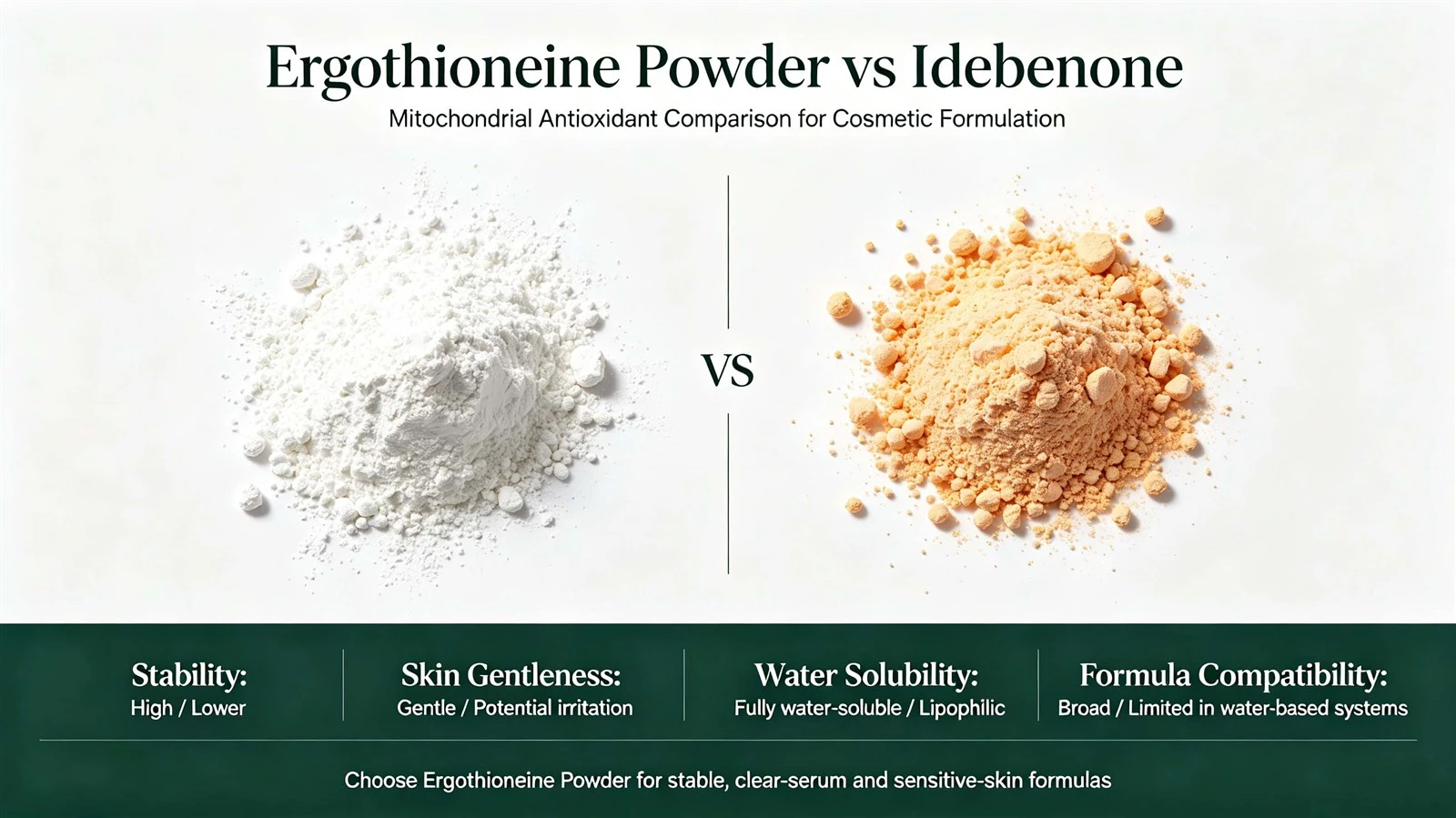
In this guide, we break down the core differences between Ergothioneine Powder and Idebenone from a cosmetic formulation perspective, answering the most searched questions from global skincare manufacturers, formulators, and brand buyers to help you select the ideal mitochondrial antioxidant for your premium skincare line.
Top 4 Most Googled Questions About Ergothioneine Powder vs Idebenone (Cosmetic Industry Focus)
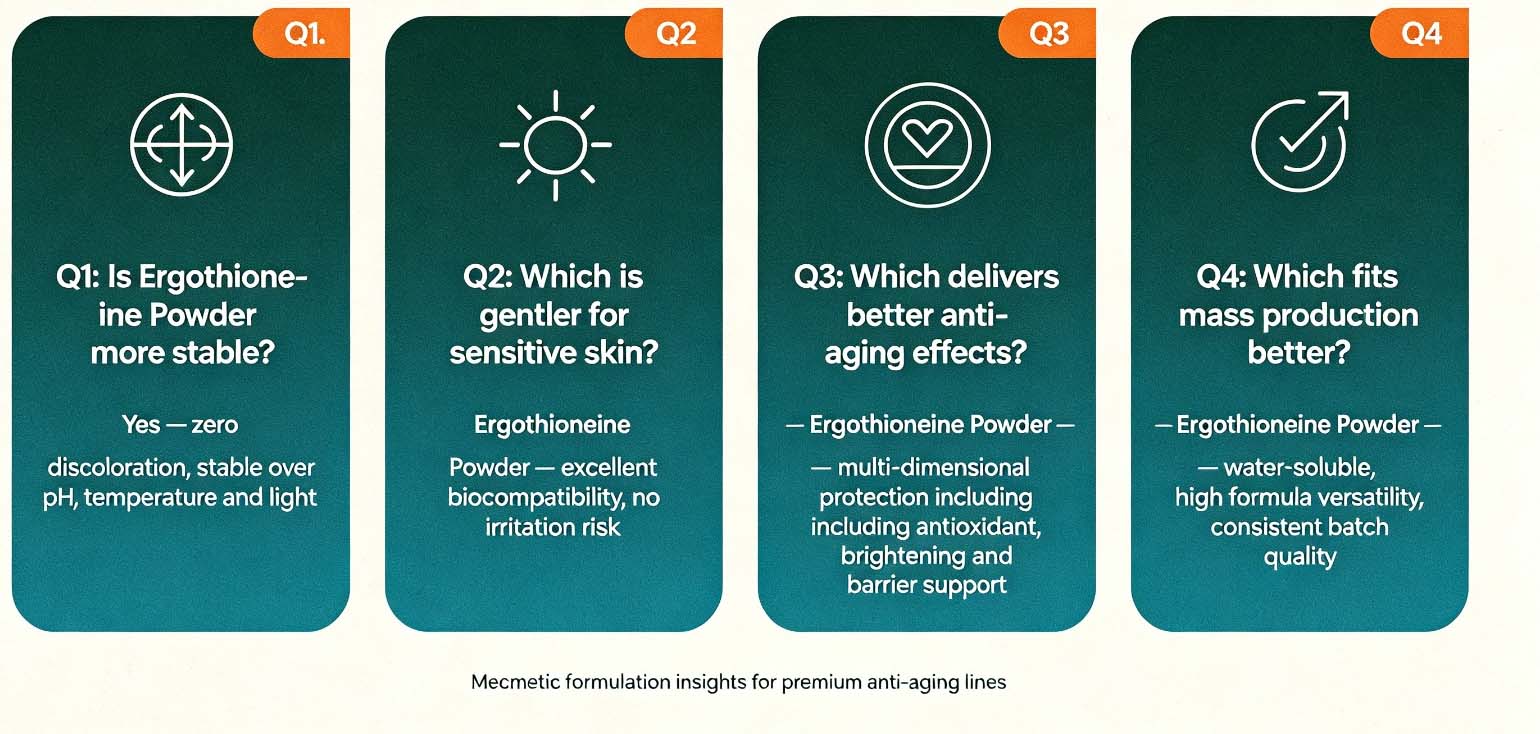
1. Is Ergothioneine Powder more stable than Idebenone in cosmetic formulations?
Stability is the biggest formulation gap between the two ingredients. Idebenone is prone to producing yellow-orange discoloration in water-based and multi-active formulas, which affects the final product appearance and limits formula flexibility. It also shows reduced activity under long-term light and high-temperature storage. In comparison, pure Ergothioneine Powder is a zero-staining, permanently active antioxidant that maintains its complete efficacy across wide pH, temperature, and light conditions. It will not oxidize or self-deplete after formulation, delivering consistent long-term anti-aging effects without affecting product color, transparency, or texture-ideal for clear serums, brightening essences, and long-shelf-life skincare products.
2. Which is safer and gentler for sensitive skin: Ergothioneine Powder or Idebenone?
Ergothioneine Powder outperforms Idebenone significantly in skin safety and gentleness. Idebenone may cause mild stinging, redness, and skin irritation for sensitive skin when used at high concentrations or combined with acidic actives. As a natural amino acid derivative existing in the human body, Ergothioneine Powder features excellent biocompatibility. It targets skin cells via exclusive OCTN1 active transport, effectively protecting mitochondria and DNA without any irritation, sensitization, or cytotoxicity. It is perfectly suitable for sensitive skincare, post-sun repair, and post-treatment soothing formulas, covering broader crowd scenarios than Idebenone.
3. Does Ergothioneine Powder provide better anti-aging and antioxidant effects than Idebenone?
Both ingredients scavenge mitochondrial free radicals, but their action mechanisms and comprehensive effects differ greatly. Idebenone mainly relies on passive penetration to remove excess free radicals, with single anti-oxidative efficacy. Ergothioneine Powder achieves multi-dimensional skin anti-aging protection: it not only neutralizes singlet oxygen and hydroxyl radicals more efficiently than Idebenone but also inhibits melanin synthesis, reduces glycation damage, repairs UV-induced cellular apoptosis, and relieves skin inflammation. Its unique recyclable active state enables sustained cellular protection, while Idebenone is consumed rapidly after exerting effects. For long-term anti-photoaging, brightening, and barrier repair, Ergothioneine Powder delivers more durable and comprehensive results.
4. Which ingredient is more suitable for mass cosmetic production and formula versatility?
Ergothioneine Powder has absolute advantages in formulation adaptability and mass production stability. Idebenone is lipophilic, requiring complex emulsification systems to add into water-based formulas, with high formula adjustment costs and compatibility limitations. Ergothioneine Powder is 100% water-soluble, compatible with water, emulsion, and cream systems, and can be freely compounded with VC derivatives, peptides, panthenol, and other common cosmetic actives without antagonism. Additionally, high-purity fermented Ergothioneine Powder supports standardized large-batch production, with stable raw material quality and lower post-formula failure rates, helping brands reduce production costs and improve product qualification rates compared to Idebenone formulas.
Choosing the right mitochondrial antioxidant is critical when developing premium anti-aging skincare. Both Ergothioneine Powder and Idebenone deliver antioxidant benefits targeting skin mitochondria, yet they come with distinct formulation trade-offs.
Idebenone remains a respected active for certain oil-based skincare formulas, but its inherent limitations - color shifting, potential skin irritation, and poor water solubility - create extra hurdles for cosmetic formulators. In contrast, high-purity Ergothioneine Powder brings unique advantages: active cellular uptake via the OCTN1 transporter, excellent stability across temperature and pH variations, no discoloration, and broad compatibility with water-based serums, essences and emulsions. It offers a gentler, more flexible option for sensitive-skin and clean beauty lines while maintaining long-lasting antioxidant activity.
Ultimately, if your brand prioritizes formula stability, simple processing, mildness and consistent finished product appearance, Ergothioneine Powder is often the superior mitochondrial antioxidant choice. We hope this comparison helps you make an informed ingredient selection for your next skincare launch.
Hatanaka T. L-Ergothioneine as an antioxidative, anti-inflammatory bioactive compound. Oxidative Medicine and Cellular Longevity. 2010;2010:891097.
Kalén J, et al. Idebenone: A review of its mechanism of action and application in topical formulations. Journal of Cosmetic Dermatology. 2016;15(4):348–354.
Gründemann D, et al. Discovery of the ergothioneine transporter OCTN1 reveals specific cellular uptake pathway. Proceedings of the National Academy of Sciences. 2005;102(48):17520–17525.
Ndiaye M, et al. Mitochondrial-targeted antioxidants for skin photo-protection: A comparative overview. International Journal of Cosmetic Science. 2021;43(3):245–258.
