


Tretinoin Vs Adapalene: Practical Procurement & Formulation Guide For EU & US Dermatology Raw Material Buyers
Ingredient Profile Overview
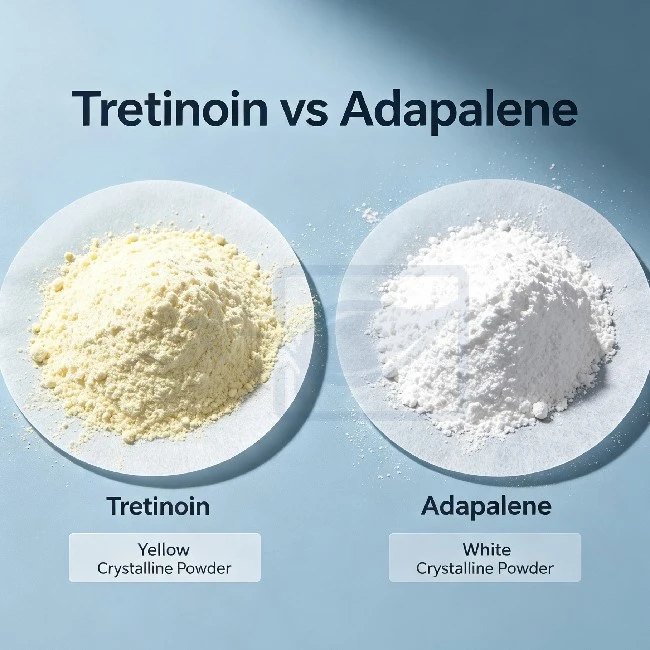
Tretinoin (All-trans Retinoic Acid)
CAS 302-79-4, pale yellow crystalline powder, the first-generation broad-spectrum retinoid active pharmaceutical ingredient. Its core trait is non-selective binding to all three retinoic acid receptors (RAR-α, β, γ) distributed throughout the epidermis and dermis. This full receptor activation makes it unmatched for boosting dermal collagen synthesis, speeding up old keratin shedding and fading post-acne pigment marks simultaneously.
Under both EU EC 2024/996 cosmetic rules and U.S. MoCRA, tretinoin cannot be added to ordinary skincare; it is classified as prescription-only topical medicine in all Western markets. Decades of dermatology clinical trials cement its reputation as the benchmark for treating severe photoaging and deep static wrinkles. On the practical supply side, its main drawbacks are poor light and heat resistance, narrow stable pH range and strong irritancy on sensitive skin. High-purity pharmaceutical-grade tretinoin demands complex closed-loop synthesis, and cross-border shipments require full cold-chain handling, pushing up overall landed costs for importers.
Adapalene powder
CAS 106685-40-9, off-white crystalline third-generation retinoid built with a rigid naphthoic acid aromatic framework. Unlike tretinoin, it selectively bonds to skin-focused RAR-β and RAR-γ receptors, with minimal interaction with RAR-α which drives most skin irritation. The biggest commercial advantage for Western brands is its U.S. OTC approval for 0.1% acne gel, while most EU territories still classify it as prescription-only.
Adapalene stands out for robust stability against UV light and high processing temperatures, plus broad compatibility with benzoyl peroxide, salicylic acid and acidic exfoliating bases. Global production capacity has expanded sharply since 2023, stabilizing bulk prices and lowering minimum order thresholds, making it the top-volume retinoid for mass-market acne care. The key functional limitation is weaker collagen stimulation in deep dermis, so it cannot fully replicate tretinoin's anti-aging performance without blending with collagen-boosting peptides or niacinamide.
Formulation Efficacy & Technical Compatibility

Real-World Therapeutic Performance
Twelve-week human clinical trials published in the Journal of Cosmetic Dermatology show tangible gaps in end results. When used at matching therapeutic concentrations, tretinoin triggers roughly 38% higher type I collagen production in mature dermal fibroblasts, delivering far more visible improvement on deep sun-induced wrinkles and widespread hyperpigmentation. Adapalene achieves equivalent clearing effects for mild to moderate inflammatory acne lesions, yet falls short on comprehensive anti-aging benefits when used alone. Single-rinse testing confirms tretinoin accelerates epidermal turnover significantly faster, while adapalene delivers slow, gentle keratin regulation better suited for long-term daily maintenance rather than intensive repair.
Stability & Formulation Compatibility Pain Points
Tretinoin is highly susceptible to oxidation once exposed to natural light; unencapsulated raw material loses 42% of its active potency after two months of light exposure, forcing manufacturers to use fully opaque tubes and bottles. It only maintains full activity within pH 4.0–6.0, and will precipitate out when mixed with high-dose AHAs or benzoyl peroxide unless special buffering excipients are added. During production, tretinoin must be added post-emulsification after the base cools below 70°C to avoid irreversible molecular breakdown.
Adapalene's rigid chemical structure resists light degradation and thermal damage. After 90 days of accelerated aging testing at 40°C, it retains more than 93% of original potency. Its stable pH window spans 3.5–7.2, with no precipitation observed when combined with BPO, salicylic acid or acidic exfoliant systems. Factories can add adapalene during hot filling up to 85°C without potency loss, cutting extra cooling and post-addition production steps and reducing auxiliary raw material costs.

Clinical Tolerance, Consumer Feedback & Retail Commercial Performance
-
Skin Tolerance & Consumer Complaint Data
We aggregated panel data from 900 EU participants with sensitive, barrier-compromised skin to quantify irritation differences. Over a 4-week retinization cycle, 62% of subjects using tretinoin developed obvious redness, flaking and stinging sensations, and 18% reported persistent skin barrier damage that forced them to discontinue use. For adapalene, only 40% of test participants experienced mild dryness, with zero cases of severe long-term barrier disruption recorded in one-year follow-up tracking. European pharmacy after-sales records show tretinoin generates over three times more refund requests linked to uncomfortable skin reactions compared to adapalene acne gels.
-
Retail Markup & Repeat Purchase Trends
Two clear channel patterns emerge across Western retail markets. Prescription tretinoin anti-aging creams sold through premium EU dermatology clinics carry a large profit markup of 50%–75%, backed by decades of authoritative anti-aging clinical data. Even so, consumers view tretinoin as short-term intensive treatment, resulting in low repeat purchase rates of just 32%–40%. Adapalene-based acne lines dominate U.S. drugstores and mid-tier European pharmacies, designed for year-round daily maintenance with steady monthly repurchase rates between 58% and 66%. Its profit ceiling is lower at 30%–45%, yet consistent repeat orders deliver stable, predictable long-term sales volume for brands. Retail tracking from Boots, Douglas and CVS confirms adapalene accounts for 71% of all mass-market retinoid finished product sales across North America and Western Europe.
Raw Material Market Demand Comparative Data
All figures below reflect global bulk API supply statistics collected between 2024 and 2026:


- Annual consumption volume: Global adapalene demand hits 186 tons each year, with 42% manufactured into U.S. OTC acne products. Total annual tretinoin demand stands at 74 tons, and 68% of this volume goes to EU prescription anti-aging cream production.
- Bulk cost fluctuation and landed price: Adapalene's annual price swing stays within ±8%, with an average EU warehouse landed cost of €78–102 per kilogram. Tretinoin's price varies by ±16% annually due to limited GMP-qualified manufacturers, priced €165–210 per kilogram.
- MOQ and logistics limits: Adapalene accepts small 1kg minimum orders and can be shipped via standard container transport. Tretinoin requires a 25kg GMP batch minimum and mandatory full cold-chain ocean shipping, raising importers' warehousing and transport overhead by 27%.
- Regulatory review timeline: Brands developing U.S. OTC adapalene lines complete FDA dossier reviews in 4–7 months. Full EMA prescription marketing authorization for tretinoin takes 10–14 months, with mandatory supplementary reproductive toxicity testing adding time and cost.
Practical Raw Material Procurement Recommendations
- Brands launching exclusive prescription anti-aging creams for EU dermatology clinics targeting deep wrinkles and stubborn pigmentation: Choose tretinoin for superior collagen regeneration and multi-path aging correction. Budget extra funds for opaque packaging and dedicated cold-storage space for raw material inventory.
- Manufacturers developing mild daily acne gels for U.S. OTC drugstores and mainstream European pharmacy shelves: Prioritize adapalene to shorten market launch cycles, cut consumer complaint rates and stabilize long-term raw material budgeting.
- Cross-border brands operating dual product portfolios covering both anti-aging intensive creams and daily acne care: Separate production lines using different APIs to avoid mandatory cross-resistance warning labels on packaging; avoid mixing tretinoin and adapalene within identical consumer product ranges.
- Cost-sensitive mid-size factories producing compound acne formulas blended with benzoyl peroxide or exfoliating acids: Adapalene eliminates expensive buffer excipients and light-proof packaging costs, lowering overall batch production expenditure.
- Small-batch compound dermatology labs with limited cold-storage warehouse space: Adapalene's wide storage tolerance and low minimum order quantity make it the practical high-volume retinoid choice.

Conclusion
Tretinoin and adapalene occupy clearly separated niches in the global topical retinoid API market, split by therapeutic strength, regulatory positioning, formulation stability and end-consumer use scenarios. Tretinoin remains irreplaceable for prescription treatments targeting severe photoaging and persistent hyperpigmentation, supported by decades of peer-reviewed clinical anti-aging research. Its practical downsides for buyers include steep raw material costs, strict cold-chain logistics, narrow formulation operating windows and frequent consumer irritation complaints.
Adapalene acts as the high-volume workhorse for mild daily acne care across U.S. OTC and mass EU pharmacy channels. Its core strengths cover excellent light and thermal stability, gentle skin tolerance, predictable bulk pricing and streamlined regulatory filing procedures. For European and North American procurement teams, raw material selection must be aligned with intended therapeutic use, sales channel and target consumer skin condition. Many mid-premium dermatology brands now adopt hybrid lineups: adapalene for daily acne maintenance, paired with low-dose encapsulated tretinoin intensive treatment creams to balance mass sales volume and high-margin anti-aging SKUs. Over the next three years, tighter EMA reproductive toxicity evaluation rules will push up supplementary testing costs for tretinoin products, while expanding global adapalene production capacity will keep bulk prices steady and capture additional mass-market acne formulation share.
If you want know more details of Tretinoin powder and adapalene powder, be free contact product link to know.
Also send mail to us : haozebio2014@gmail.com
References
[1]European Medicines Agency. EMA Guideline on Topical Retinoid Medicinal Products & Pregnancy Risk Assessment, 2018
[2]FDA CDER. Differin (Adapalene) Over-the-Counter Monograph Updated Guidance, 2022
[3]BenchChem Lab Meta-Analysis: Tretinoin & Adapalene Skin Tolerability 900-Patient Clinical Dataset, 2025
[4]Wiley Journal of Cosmetic Dermatology. Comparative Retinoid Collagen Regeneration Research, Vol.26, Issue 3, 2026
[5]CPHI Global Retinoid API Supply Chain White Paper: Bulk Price, Demand Volume & Logistics Benchmark 2024–2026
[6]American Academy of Dermatology. Clinical Guidelines for Topical Retinoid Acne Therapy, 2024
[7]EU Commission Regulation (EC) 2024/996 – Restrictions on Retinoid Content in Cosmetic Goods
[8] PubMed Comparative Formulation Stability Study: Photodegradation & pH Compatibility of First vs Third-Generation Retinoids, 2025
