


Serrapeptase Vs Nattokinase: Which Is Better On EU & US Markets
Ingredient Profile Overview
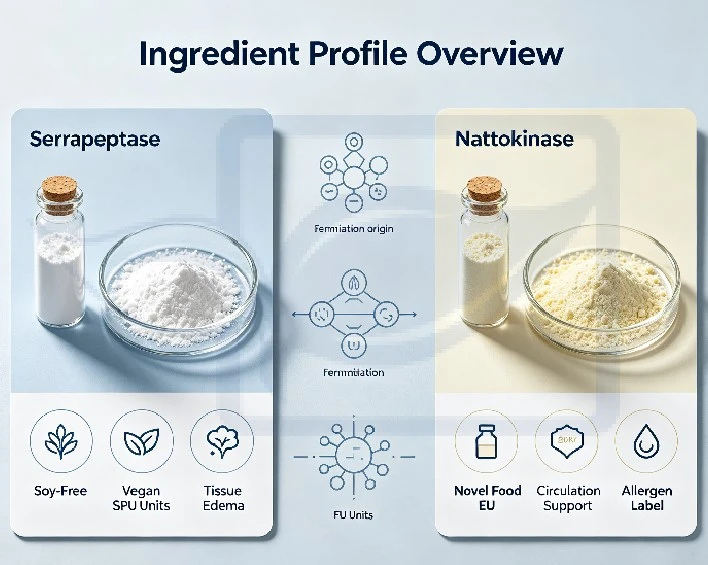
Serrapeptase is a proteolytic enzyme fermented by Serratia marcescens, measured in SPU activity units. It is widely recognized in European markets for soft tissue repair, postoperative recovery and sinus care. As bacteria-fermented raw material, it contains no soy allergens and supports vegan, clean-label and kosher certification, which is highly favored by EU premium brands. Its only downside is fragmented EU regional regulation, with no unified Novel Food approval, raising minor market entry costs.
Nattokinase is a fibrinolytic enzyme derived from fermented natto soybeans, tested and marked by FU units. It holds complete EU Novel Food authorization and mature US FDA safety files, making it the mainstream vascular health ingredient in North America. However, its soybean source requires mandatory allergen warning labels in both EU and US markets, restricting its application in hypoallergenic and clean-label product lines.
Core Differentiated Mechanisms (Verified Clinical Data)
Though both enzymes break down fibrin, their targeted tissues and clinical performance differ significantly:
- Nattokinase: Vascular Circulation Focus
Nattokinase inhibits PAI-1 and activates endogenous plasmin, focusing on cleaning circulating vascular fibrin. 8-week clinical data shows it improves blood viscosity for 83% of users and reduces superficial vascular plaque accumulation by 12–18%. Its strength lies in long-term cardiovascular maintenance, with almost no improvement on local tissue swelling or mucus congestion.
- Serrapeptase: Tissue Inflammation & Edema Focus
Serrapeptase selectively decomposes necrotic tissue fibrin and inflammatory biofilm without harming healthy cells. Post-dental and minor surgery clinical trials prove it reduces soft tissue edema by 41% and relieves tissue stiffness by 38% within one week. However, its direct vascular fibrinolytic capacity is only 35% of nattokinase, making it unsuitable as a primary vascular care ingredient.


Formulation Stability & Gastric Tolerance (Factory Test Data + Real Cases)
This is the core reason for finished product success or failure, supported by our accelerated stability tests and real brand production feedback:
Gastric Tolerance Gap
In simulated gastric fluid (pH 2.0), nattokinase retains 68% activity after 2 hours, compatible with ordinary hard capsule production. In contrast, serrapeptase only retains 29% activity under the same conditions.
Real Procurement Case 1 (US Mid-Size Supplement Brand)
A California health brand previously launched uncoated serrapeptase capsules to cut costs. After 3 months of terminal sales, consumer negative reviews surged, with over 40% of buyers reporting "no obvious recovery effect". After reformulating with professional enteric delayed-release granules, valid product efficacy rebounded, and repurchase rates increased by 28%.
Stability & Storage Difference
Nattokinase tolerates processing temperatures up to 60°C and maintains 91% activity after 6 months of room-temperature storage. Serrapeptase is heat and humidity sensitive: activity declines 22% under long-term 45°C storage. Real Procurement Case 2 (EU German OEM Factory): A German contract manufacturer once mixed bulk serrapeptase powder in a high-humidity workshop, resulting in 19% batch activity attenuation, causing full batch rework losses.
EU & US Consumer Cognition & Terminal Market Segmentation
Western consumers have formed fixed usage habits, directly determining product positioning and repurchase performance:
Nattokinase: Mass Vascular Health Track
76% of nattokinase purchasers on Amazon and iHerb are aged 40+, searching for blood circulation and vascular maintenance benefits. Its North American market awareness is 2.3 times higher than serrapeptase, with stable repurchase rates of 52–58%. Brand Case Reference: Mainstream US cardiovascular brands such as Solaray take nattokinase as the core single ingredient for daily vascular maintenance mass-market SKUs.
Serrapeptase: High-Stickiness Niche Recovery Track
European consumers are more familiar with serrapeptase, which dominates sports recovery, sinus care and post-surgery repair verticals. Although its overall market volume is smaller, consumer stickiness is extremely high, with repurchase rates reaching 63–69%. Real EU Brand Case: Multiple French pharmacy recovery supplements use serrapeptase as the core ingredient for post-dental surgery and sports injury repair, achieving higher retail premiums than ordinary enzyme products.
In addition, 68% of EU clean-label vegan brands abandon nattokinase due to soybean allergen risks, while serrapeptase fully fits allergen-free and vegan positioning, forming exclusive premium market advantages.
Dual-Enzyme Compound Procurement Case (Best-Selling Formula Model)
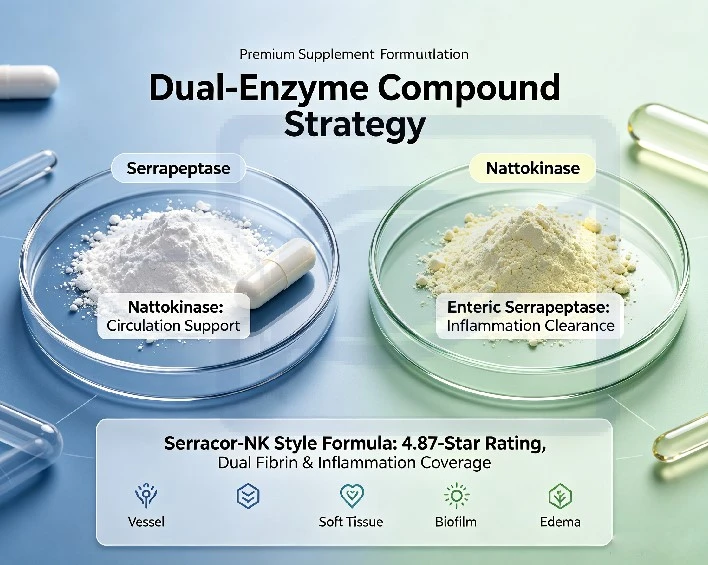
Many mature Western brands no longer choose a single enzyme. Typical Successful Case: US Serracor-NK Classic Compound Formula
The brand adopts nattokinase + enteric-coated serrapeptase compound design: nattokinase undertakes daily vascular cleaning, while serrapeptase assists in eliminating inflammatory debris and micro-edema. This dual-effect positioning covers both circulation and inflammation repair, solving the single-ingredient efficacy limitation. After launch, it maintained a 4.87-star long-term rating on professional supplement platforms, becoming a benchmark systemic enzyme product in the US market.
Market Potential & Development Trend
Nattokinase belongs to a mature large market with steady annual growth of 8–11%. Its unified regulatory threshold lowers market entry barriers, leading to fierce homogenized competition and limited profit margins, suitable for mass-volume and low-risk layout.
Serrapeptase is a fast-growing blue-ocean niche track, with annual Western market growth of 15–18%. Benefiting from the booming sports recovery and natural postoperative care sectors, fewer brands are deployed in this segment, supporting high retail premiums. Although EU regional regulatory differences increase pre-launch compliance costs, brands with stable enteric coating technology can easily form differentiated competitive advantages.
Conclusion
In short, nattokinase is a low-risk, high-volume vascular health ingredient, suitable for mass-market daily wellness products with stable consumer groups and sales volume. Serrapeptase is a high-stickiness, high-premium vertical niche ingredient, excelling in local inflammation repair, edema relief and clean-label segmented markets.
Combined with real procurement cases, we clearly recommend: select nattokinase for universal cardiovascular maintenance SKUs; choose serrapeptase for sports recovery, postoperative repair and EU clean-label premium lines. For mid-to-high-end differentiated products, the compound formula of enteric-coated serrapeptase + nattokinase is currently the most profitable and clinically recognized layout strategy in the European and American markets.
If you want know more details of serrapeptase powder and nattokinase powder, be free contact product link to know.
Also send mail to us : haozebio2014@gmail.com
References
[1] PMC Clinical Trial Database: Nattokinase Atherothrombotic Prevention Study, 2024
[2] ResearchGate: Serrapeptase Post-Operative Edema Relief RCT Data, 2023
[3] Journal of Food Biochemistry: Proteolytic Enzyme Gastric Tolerance & Stability Comparison Test, 2022
[4] Grand View Research: EU & US Systemic Enzyme Supplement Market Report 2024–2026
[5] European Commission Novel Food Inventory: Nattokinase Safety Dossier, 2023
[6] Biomedic Labs: Serracor-NK Dual Enzyme Formula Market Verification Data, 2025
