


Azelaic Acid Powder Vs PAD: A Guide To Choosing The Right Raw Material

People are looking for skincare products that do things like help with acne improve skin tone and balance oil. One ingredient that is getting a lot of attention is azelaic acid. It has been used for a time and has many benefits for the skin. However using azelaic acid powder can be tricky especially when it comes to dissolving it in water and making sure it does not crystallize.
Companies that make skincare products need to decide whether to use azelaic acid or its water-soluble version, Potassium Azeloyl Diglycinate (PAD). This decision is not about the cost of the raw material but also about the molecular structure how well it dissolves how easy it is to process and how well it works with other ingredients.
This guide will compare azelaic acid and PAD from angles to help companies make informed decisions about which raw material to use.
What Are the Differences in the Chemical Structure of Azelaic Acid and PAD?
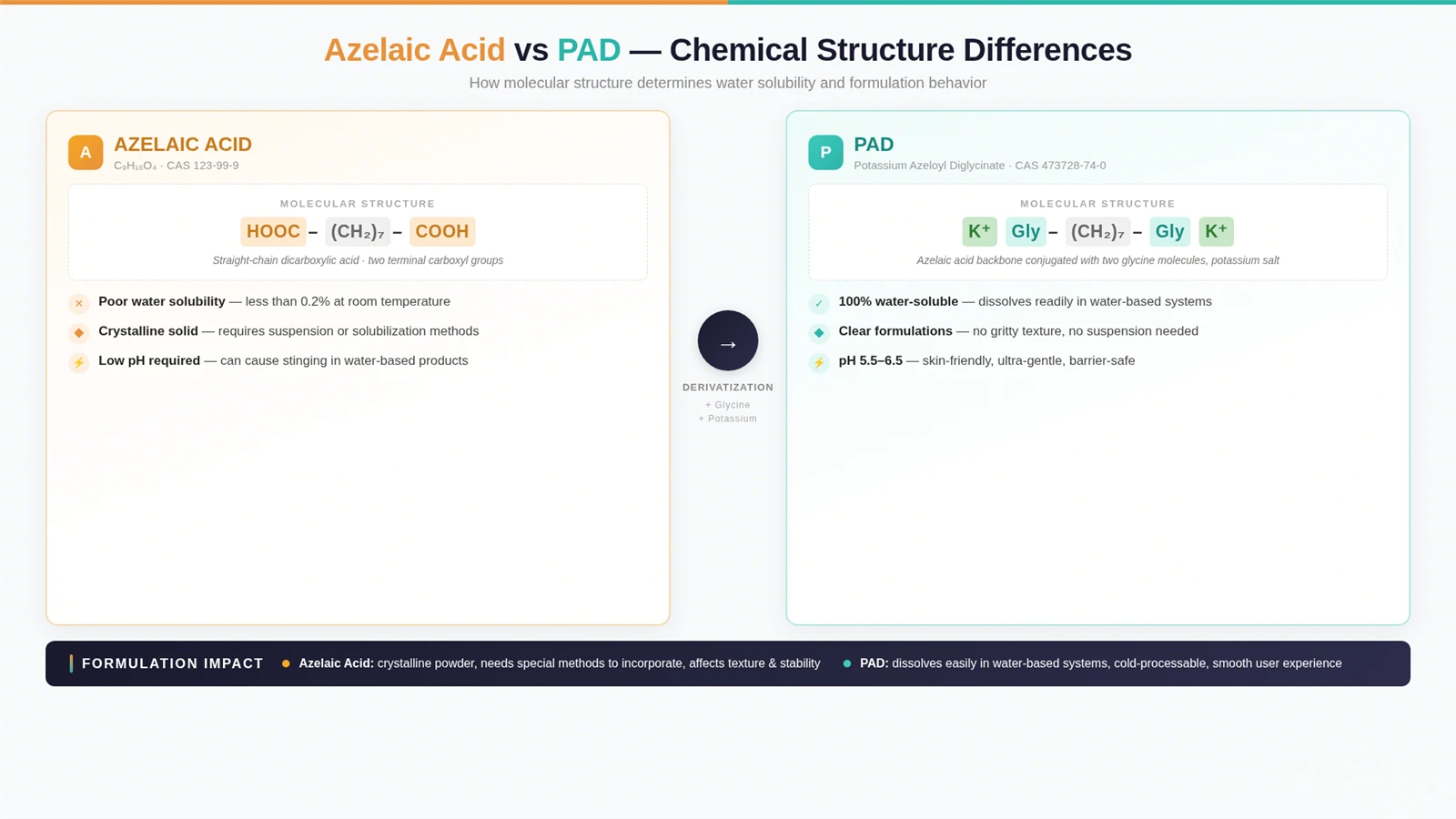
The main difference between azelaic acid and PAD is their structure. Azelaic acid is an ingredient with a straight-chain structure that has two carboxyl groups. This structure makes it work well for the skin. It also makes it hard to dissolve in water. At room temperature azelaic acid does not dissolve well in water, which can make it hard to use in skincare products that are based on water.
On the hand PAD is made by combining azelaic acid with glycine and then adding potassium. This makes PAD more soluble in water and easier to use in skincare products that are based on water.
From a formulation perspective the difference is clear:
* Pure azelaic acid powder is usually a crystalline solid that needs methods to mix it into formulations.
* PAD is better for water-based systems because its structure makes it dissolve better.
Companies that make skincare products need to understand this difference because it affects how they make their products the texture, the stability and how people experience the product.
How Well Does Pure Azelaic Acid Powder Work in Terms of Solubility and Processing?
For companies that use azelaic acid powder controlling the process is very important. Although azelaic acid is very useful it does not dissolve well in water, which means companies need to use strategies to formulate it.
In products that have a concentration of azelaic acid companies may need to use extra steps like micronization, high-shear dispersion or special mixing procedures. These processes can increase the need for equipment and production time.
During manufacturing some technical issues can happen:
* If the particles are not mixed well it can make the skin feel rough.
* If the temperature is not controlled well it can make the azelaic acid crystallize again.
* If the pH is not right or if it does not work well with polyols it can affect the long-term stability of the product.
* If the particles are not mixed well it can affect how the product looks and feels.
Experienced formulation teams usually optimize the process carefully. For example controlling the temperature choosing the emulsifiers and mixing it well can help reduce the clumping of particles.
However pure azelaic acid is still an option for certain product ideas especially when companies want to highlight the active ingredient or make suspension-based formulations.
Why Is It Important to Choose the Right Potassium Azeloyl Diglycinate Supplier for Water-Based Formulations?
For companies that make serums, toners and water-based skincare products PAD is a good option.
A good potassium azeloyl diglycinate supplier should provide not the raw material but also detailed quality documents, including a Certificate of Analysis (COA) specification data and information about batch consistency.
The advantages of PAD in water-based formulations come from its solubility in water. Compared to azelaic acid PAD can be mixed into water phases easily which reduces the need for complicated dispersion procedures.
When evaluating PAD suppliers companies should consider:
* How pure the PAD is and how consistent it is.
* How free azelaic acid is left.
* How the PAD. Its physical stability.
* The results of metal tests.
* The data on control.
* How consistent the batches are.
These quality factors are important because impurities or inconsistent raw material characteristics can affect the stability of the formulation and how it feels on the skin.
For companies supplier transparency is also important for complying with regulations. Documents that support ingredient traceability, testing methods and quality control systems help reduce risks during product registration and market expansion.
Which Azelaic Acid Derivative Offers Better Skin Tolerance and Efficacy?
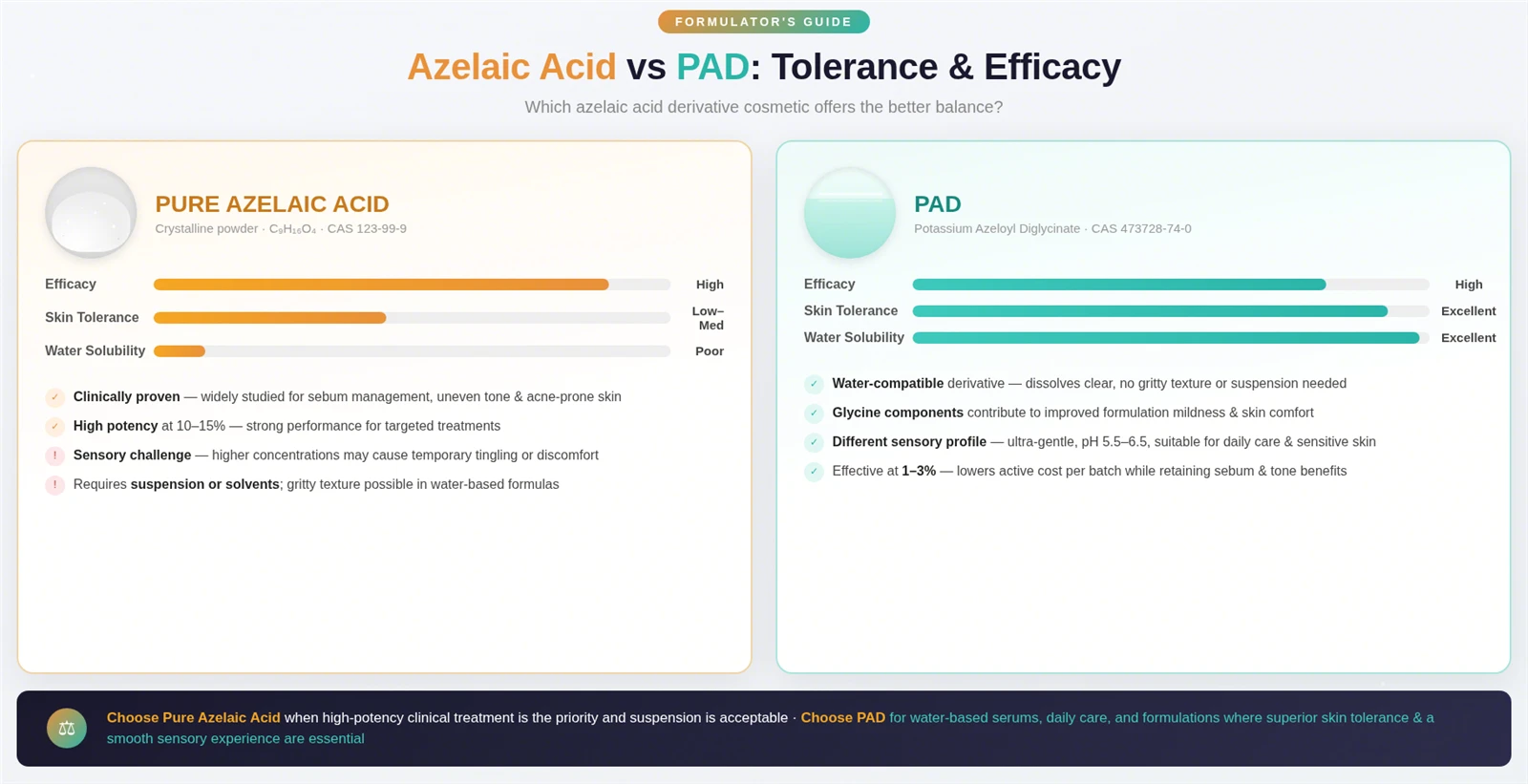
Pure azelaic acid has been widely studied for applications related to sebum management, uneven skin tone appearance, and acne-prone skin care. However, higher concentrations may create sensory challenges for some users, including temporary tingling or discomfort depending on formulation design.
PAD was developed as a more water-compatible derivative. The presence of glycine components may contribute to improved formulation mildness and a different sensory profile compared with traditional acid-based systems.
In practical cosmetic development, the choice depends on the overall formula rather than the ingredient alone. Factors such as:
* Product pH.
* Supporting active ingredients.
* Preservative system.
* Humectants.
* Skin barrier-supporting ingredients.
can influence final product performance.
For example, PAD may be considered in formulas combining niacinamide, moisturizing agents, or lightweight hydration systems because of its water compatibility. Pure azelaic acid may be preferred in products where a higher direct acid content and suspension format are acceptable.
Before commercialization, brands generally conduct stability testing, compatibility evaluation, and safety assessments according to their target market requirements.
Quality Control and Procurement Considerations for Cosmetic Manufacturers
Raw material selection is closely connected with supplier evaluation. Whether purchasing pure azelaic acid or PAD, cosmetic companies should review supplier capabilities beyond basic pricing.
Important evaluation points include:
* Manufacturing quality management systems.
* Raw material testing procedures.
* Stability data.
* Technical documentation support.
* Regulatory compliance assistance.
International buyers commonly request documents such as COA, Safety Data Sheet (SDS), technical data sheets, and product specifications before approving a new ingredient supplier.
A professional supplier relationship can help brands shorten formulation development cycles and improve consistency during commercial production.
Conclusion
Choosing between Pure azelaic acid powder and PAD depends on product positioning, formulation system, production capability, and target market requirements. Traditional azelaic acid remains suitable for certain high-active or suspension formulations, while PAD offers advantages for water-based cosmetic systems requiring improved solubility and processing convenience.
For cosmetic brands, OEM manufacturers, and ingredient distributors seeking suitable raw materials, Haoze Biotechnology provides cosmetic-grade azelaic acid and PAD solutions with technical documentation and formulation support.
If you want know more details of Pure azelaic acid powder, be free contact product link to know.
Also send mail to us : haozebio2014@gmail.com
References
1. Petrovici, A. G., Spennato, M., Bîtcan, I., Péter, F., Cotarcă, L., Todea, A., & Ordodi, V. L. (2025).
A Comprehensive Review of Azelaic Acid Pharmacological Properties, Clinical Applications, and Innovative Topical Formulations.
Pharmaceuticals, 18(9), 1273.
https://doi.org/10.3390/ph18091273
2. Mastrofrancesco, A., Ottaviani, M., Cardinali, G., Flori, E., Briganti, S., & Picardo, M. (2010).
Antioxidant and Anti-Inflammatory Properties of Azelaic Acid in Human Keratinocytes.
Archives of Dermatological Research.
3. Kircik, L. H. (2011).
Azelaic Acid: Mechanisms of Action and Clinical Applications in Dermatology.
Journal of Drugs in Dermatology.
4. Fitton, A., & Goa, K. L. (1991).
Azelaic Acid: A Review of its Pharmacological Properties and Therapeutic Efficacy in Acne and Hyperpigmentation Disorders.
Drugs, 41, 780–798.
5.Veraldi, S., et al. (2014).
Treatment of Symptoms of Erythemato-Telangiectatic Rosacea with Topical Potassium Azeloyl Diglycinate and Hydroxypropyl Chitosan: Results of a Sponsor-Free, Multicenter, Open Study.
Journal of Dermatological Treatment, 25(6), 485–488.
https://doi.org/10.3109/09546634.2014.921275
6. Berardesca, E., Iorizzo, M., Abril, E., Guglielmini, G., Caserini, M., Palmieri, R., & Piérard, G. E. (2012).
Clinical and Instrumental Assessment of the Effects of a New Product Based on Hydroxypropyl Chitosan and Potassium Azeloyl Diglycinate in the Management of Rosacea.
Journal of Cosmetic Dermatology, 11(1), 37–41.
https://doi.org/10.1111/j.1473-2165.2011.00598.x
7. Mrowietz, U., & Hartmann, A. (2013).
Azelaic Acid in Dermatology: Current Applications and Future Perspectives.
Clinical, Cosmetic and Investigational Dermatology.
8. Draelos, Z. D. (2018).
Cosmetic Dermatology: Products and Procedures (2nd Edition).
Wiley-Blackwell.
9. Pleguezuelos-Villa, M., et al. (2021).
Preparation and Evaluation of Azelaic Acid Topical Microemulsion Formulation: In Vitro and In Vivo Study.
Pharmaceutics, 13(3), 357.
10. U.S. Food and Drug Administration (FDA).
Cosmetic Products: Regulations and Guidance.
https://www.fda.gov/cosmetics
11. European Commission.
Cosmetic Products Regulation (EC) No 1223/2009.
https://single-market-economy.ec.europa.eu/sectors/cosmetics_en
12. ISO 22716:2007.
Cosmetics - Good Manufacturing Practices (GMP) - Guidelines on Good Manufacturing Practices.
International Organization for Standardization.
https://www.iso.org/standard/36437.html
