


Sodium PCA Powder Vs Sodium Lactate: Which NMF Humectant Is Best For Your Formula?
 When you're formulating high-performance hydrating skincare, picking the right humectant can make or break your product's texture, skin-friendliness, and overall user experience. Both Sodium PCA Powder and Sodium Lactate are part of the skin's natural moisturizing factor (NMF), making them go-to ingredients for cosmetic chemists worldwide. At a glance, they look interchangeable, but small differences in hydration, skin feel, pH behavior, hair care performance, and long-term stability set them apart.
For brand owners and lab developers, choosing between the two comes down to balancing cost-efficiency with a premium sensory feel. Here is a breakdown of how they compare to help you decide which one fits your next project.
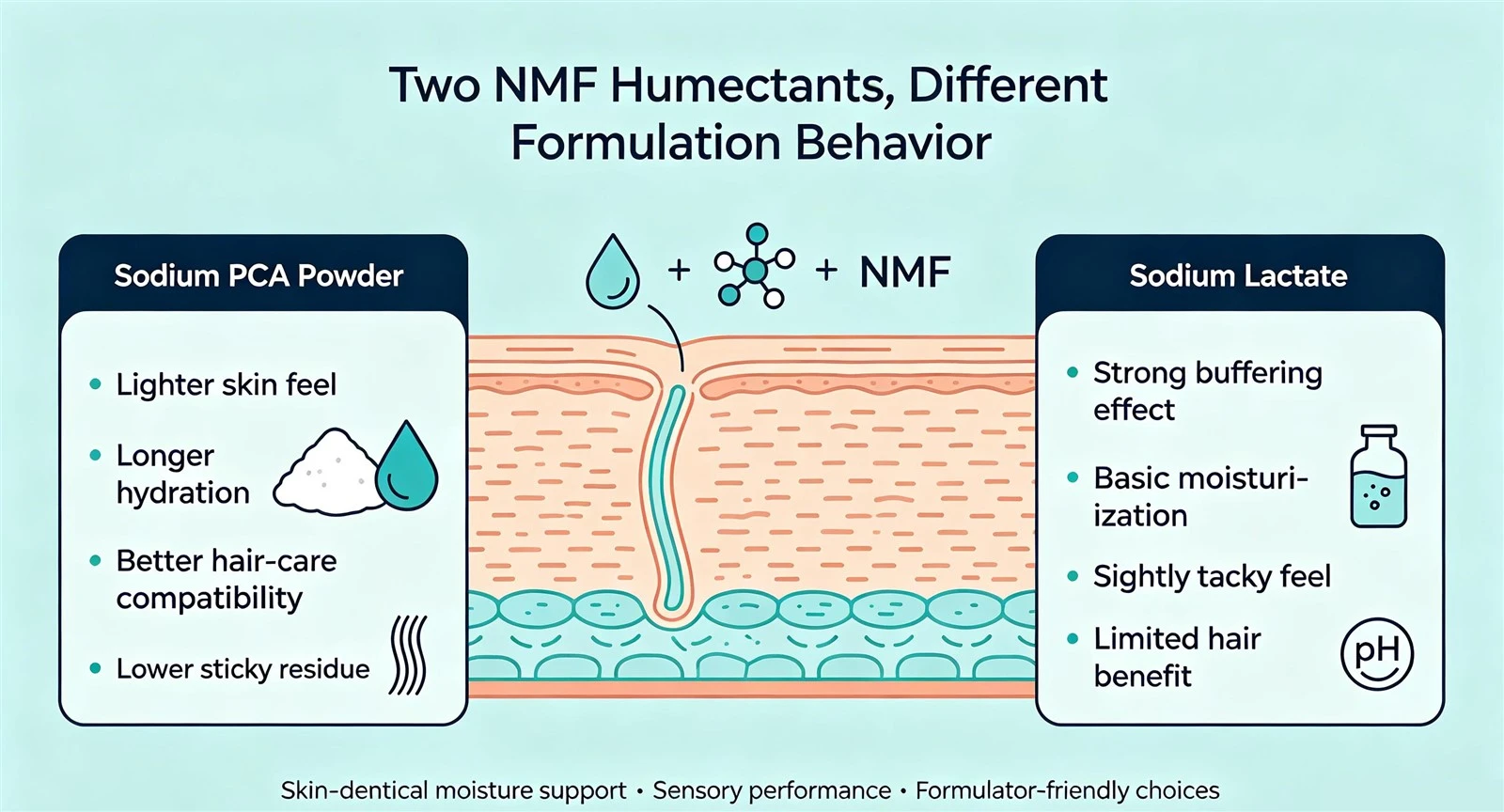
1. Which one gives a lighter, less-sticky skin feel?
Sodium PCA Powder wins on a lightweight, non-sticky finish.
When you look at sensory performance, Sodium PCA Powder consistently feels lighter and less tacky than Sodium Lactate at the same concentration.
While Sodium Lactate is a great moisturizer, it tends to leave a slightly sticky residue if you use too much of it. That can hurt the user experience in lightweight serums, oil-free moisturizers, or facial mists where people expect a fast-drying, clean touch.
Sodium PCA binds water without leaving that heavy, lingering feel. Formulators usually reach for it when they want a smooth, fresh, skin-like finish, especially for premium products where comfort is everything.
2. How do they compare in hydration and reducing moisture loss?
They both draw in moisture, but Sodium PCA excels at long-term barrier support.
Both are proven humectants that pull moisture from the air into the skin and support your skin barrier. Their core mechanism is similar, but they behave differently over time.
Sodium Lactate gives you a great initial burst of hydration. However, Sodium PCA Powder is exceptional at reducing transepidermal water loss (TEWL) over the long haul, giving you lasting hydration rather than just a quick surface fix. Because Sodium PCA is already abundant in our skin's natural moisturizing factor, it works seamlessly with the skin's own systems. Sodium Lactate is great for basic dry skin formulas, but Sodium PCA is usually chosen for high-end lines aiming for deep, barrier-friendly hydration.
3. What about pH stability and how they mix with other ingredients?
Sodium PCA offers more flexibility; Sodium Lactate acts as a buffer.
This is a big one for lab developers. Sodium Lactate has strong buffering properties-it can shift and stabilize the pH of your formula, which is handy if you need a mild adjustment. The downside is that this buffering can mess with sensitive, carefully calibrated active ingredients.
Sodium PCA Powder is much more neutral and doesn't mess with your formula's pH as much. It stays stable across a wide pH range and plays nicely with most common actives like hyaluronic acid, niacinamide, panthenol, plant extracts, and vitamins. If you're building a complex, multi-active serum where exact pH control is critical, Sodium PCA gives you more freedom and lowers the risk of unexpected pH drift. (Both are water-soluble and safe for leave-on or rinse-off products when used at recommended levels.)
4. Can Sodium PCA replace Sodium Lactate in hair care too?
Yes, and it actually performs much better in hair care.
Sodium PCA Powder can easily swap in for Sodium Lactate in almost all skincare products, and it brings a clear edge to hair care where Sodium Lactate doesn't do much.

In skincare-like moisturizers, toners, masks, and cleansers-Sodium PCA gives you equal or better hydration with a nicer skin feel. For hair care (shampoos, conditioners, and leave-in treatments), Sodium PCA gently binds to hair keratin to boost softness, flexibility, wet-combing, and shine. Sodium Lactate isn't really used for targeted hair conditioning.
That said, if you're doing a direct one-to-one replacement in an existing formula, always run a small batch test first. Since Sodium Lactate acts as a pH buffer, you might need to make a quick pH adjustment after switching to Sodium PCA.
