


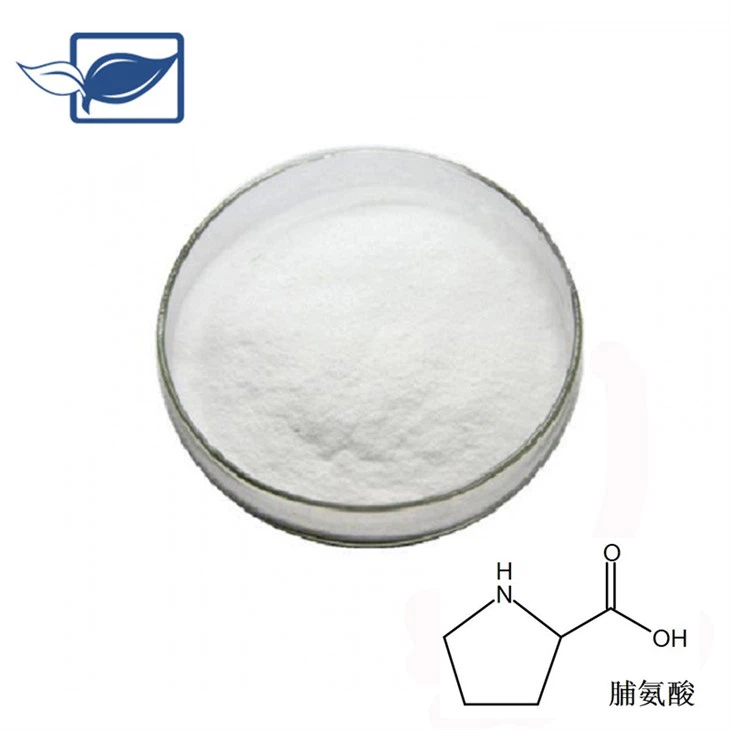


Proline
1. Product name: Proline
2. Appearance: White powder
3. Molecular formula: C5H9NO2
4. Molecular weight: 115.13
5. CAS number: 147-85-3
6. Purity: 99%
7. Test method: HPLC
8. Payment method: TT, Western Union, Paypal, Pingpong, Xtransfer, etc.
9. Shelf life: 2 years

Product introduction:
Proline (abbreviated as Pro or P), with a chemical formula of C5H9NO2 and a molecular weight of 115.13, is a cyclic amino acid. It is an α-amino acid, neutral, with an isoelectric point of 6.30. It is more soluble in water than any other amino acid, with about 162 g soluble in 100 g of water at 25°C. It is easy to deliquesce and difficult to crystallize, and has a sweet taste. When heated with ninhydrin solution, it produces a yellow compound. Once it enters the peptide chain, it can undergo hydroxylation to form 4-hydroxyproline, which is an important component of animal collagen. Hydroxyproline is also present in many plant proteins, especially related to the formation of cell walls. Plants often have obvious accumulation of proline under various adverse conditions such as drought, high temperature, low temperature, and salinity. It has a wide range of applications in clinical, biomaterials, and industry [1]. We know that proline has three forms: DL-proline, L-proline, and D-proline. The proline usually referred to is L-proline, a naturally occurring amino acid. At room temperature, this product is a columnar crystal. It decomposes rapidly when heated to 215-220°C. It is soluble in hot water and ethanol. It has a slightly sweet taste and is hygroscopic. It racemizes in alkaline solutions. [α]D25-86.5° (water), -60.4° (5N hydrochloric acid). It is distributed in many proteins. It is an amino acid with a moderate content in marine plankton; it also exists in seawater, particulate matter, and marine sediments.
Proline is a non-essential amino acid for the human body. The human body can synthesize it by itself. Among the 20 protein-forming amino acids, its most special feature is that the amine nitrogen is bound to not one but two alkyl groups, thus giving it a secondary amine structure. Natural proline is L-type, and the configuration of the chiral carbon is S.

Physical and chemical properties
Physical properties
Appearance and properties: white crystalline powder
Density: 1.35
Melting point: 228°C (dec.) (lit.)
Boiling point: 252.2ºC at 760 mmHg
Flash point: 106.3ºC
Refractive index: -85° (C=4, H2O)
Water solubility: soluble
Stability: stable, incompatible with strong oxidants
Storage conditions: room temperature
Vapor pressure: 0.00615mmHg at 25°C
Isoelectric point (pI): 6.30
Chemical properties
Colorless needle-shaped crystals can be obtained from ethanol/ether, and orthorhombic crystals can be obtained from water. It has a strong sweet taste. It reacts with hydrated ninhydrin test solution to produce yellow, but turns red after being acidified with glacial acetic acid. It reacts with ammonium thiocyanate to produce insoluble salts.
Note*: The valence of N is +5.
Polarity
Proline is a polar molecule from the perspective of its entire molecular structure, but it is a non-polar amino acid. This is because the polarity of an amino acid is determined by the properties of its side chain rather than the entire amino acid molecule. In reality, there are many non-polar amino acids that are polar molecules like this.

OEM Service


Function and Application:
Proline and its derivatives are often used as symmetric catalysts in organic reactions, with CBS reduction and proline-catalyzed aldol condensation being prominent examples.
L-Proline is an osmoprotectant and therefore useful in a variety of pharmaceutical and biotechnological applications.
During brewing, proteins are rich in proline which binds to polyphenols to create haze (turbidity).
Proline is a cyclic imino acid and an important component of animal collagen. Plants often accumulate proline significantly under various adversities such as drought, high temperature, low temperature, and salinity. It is widely used in clinical, biomaterials, and industry.
The structure of proline is unique because it is the only protein amino acid (the type that forms proteins through biosynthesis) with a secondary amine. It not only helps "build" proteins, but also acts as a catalyst in many organic reactions.
Helps heal wounds and repair skin
One of the main functions of proline is to help repair skin injuries such as wounds, cuts, and burns. It can participate in the three stages of wound healing because it stimulates cell migration and helps the development of new tissue. Studies have found that in the early stages of wound healing, the level of proline in wound fluid is at least 50% higher than the plasma level, indicating that proline actively enters the wound site.
Proline does this by supporting collagen synthesis, or the formation of new collagen. Collagen is an important component of wound healing because it provides structure and strength to our skin. Some studies have found that collagen supplements containing proline can improve skin barrier function, induce the synthesis of hyaluronic acid, and promote the growth and migration of fibroblasts.
Since the body produces less collagen as we age, which can affect the appearance of the skin, consuming more collagen-forming proline can effectively keep the skin looking younger.
Supports Digestive Health
Collagen has become one of the supplements that improves gut health, treats leaky gut syndrome, and therefore supports overall immune system function. What does proline do when it comes to supporting digestive health? The amino acids in collagen can help strengthen gastrointestinal tissue, facilitate nutrient absorption, and prevent autoimmune reactions.
Research has found that proline and other amino acids in collagen support the gut and gut-associated lymphoid tissue by improving the body's immune defenses and ability to fight off foreign antigens and pathogens. Each amino acid has unique properties that affect gut health, including: maintaining gut integrity, growth, and function; normalizing inflammatory cytokine secretion; increasing T lymphocyte counts; and regulating IgA cell secretion.
Helps Prevent Joint Pain
Aging is one reason for increased joint pain, and starting around age 30, we begin to produce less collagen. Collagen is needed to help maintain the strength and flexibility of connective tissue. Unhealthy diet, lifestyle, and habits can accelerate collagen loss because these can lead to higher levels of inflammation, oxidative stress, hormonal imbalances, and nutrient deficiencies.
Getting more collagen-forming amino acids, including proline, can help mitigate these effects by promoting the formation of new cartilage, helping muscle growth, and maintaining and even helping to improve bone density.
Proline and other amino acids can strengthen cartilage by stimulating chondrocytes. Studies have found that proline has a positive effect on animal tissue growth and performance. It also helps improve antioxidant status, which can help reduce inflammation and oxidative stress, which can help prevent joint pain.
Supports the Cardiovascular System
Proline can help protect the heart and artery walls, such as preventing fat from accumulating in the blood and controlling blood pressure. Amino acids are needed to form the tissue that builds blood vessels/arteries. Getting more collagen-forming amino acids may help reduce the risk of atherosclerosis (thickening or hardening of the arteries).
Contributes to Healthy Metabolism and Fights Inflammation
Proline plays a beneficial role in metabolic function and the synthesis of other compounds. It acts as a signaling molecule and sensor of the energy status of the cell. It can help regulate mitochondrial function, affect cell proliferation, cell death, and trigger specific gene expression.
Other beneficial effects of proline on energy production and overall health include boosting metabolism and muscle mass, aiding energy output during physical activity, improving the body's use of antioxidants, promoting the process of DNA and RNA building healthy cells, supporting phase II liver detoxification, and supporting the central nervous system.
A 2017 study conducted on rats found that when the rats experienced inflammation, oxidative stress, and altered energy parameters in parts of the brain, taking proline was able to prevent some of these harmful effects.

Delivery& packaging
We will packaging the capsule with bottles (bottle/bag/jar) inside, and will packaging the bottles with box.
If you have wanted packaging, we can arrange packaging according your inquire.

FAQ
Q1: Could you help us customization label to me?
Yeah, our designer can arrange customization label accordingly your inquire.
Q2: Could I make payment through cryptocurrency?
We only accept payment with bank transfer and cash at present.
Q3: Which payment method you accept?
We can accept TT, Western Union, Xtransfer, Pingpong,ACP, ect.
Q4: When can product delivery?
Delivery time will according your quote details quantity and customization service. The more details will send to you by our manager.
Our Xi'an Haoze Biotechnology are professional supplier of kinds of materials powder and customization service about these materials, included Proline. If you have interested,welcome to contact us info@haozbio.com
Hot Tags: proline, suppliers, manufacturers, customized, wholesale, buy, bulk, high quality, low price, OEM service, Antimicrobial, Magnesium Stearate Powder, Respiratory Digestive And Urinary System, MCC Powder, Nervous System


